
16th Century – The Century of the Reformation
The Catholic Middle Ages came to an end in the Kingdom of Sweden, of which Finland was a part. The Reformation stripped churches of their gold and decorations, and Protestant Lutheranism became the dominant religion.
During the 16th century, the period known as the Middle Ages gave way to the early modern era. Across Europe, the winds of the Reformation spread, reaching Finland through the actions of King Gustav Vasa of Sweden. Over the course of the century, Lutheran doctrines were gradually adopted in the Diocese of Turku, transforming both the content and appearance of church life. The New Testament was also published in Finnish for the first time. In 1554, a second diocese, the Diocese of Vyborg, was established to serve the easternmost regions.
From the mid-16th century onward, Turku Castle was greatly expanded under Duke John, bringing Renaissance court life to the city. Most of the burghers of Turku had previously been descendants of German Hanseatic merchants, but their influence began to shift into the hands of native townspeople. Foreign trade flourished, and the standard of living improved. By the end of the century, Turku had a population of just over 3,000 inhabitants.
The Beatification of Bishop Hemming – The Final Act of the Middle Ages
Do you still remember Bishop Hemming from the Middle Ages? He was introduced in the section on the 14th century.
Bishop Hemming, who died in 1366, remained strongly present in the Cathedral even after his death. As late as the early 16th century, a candle was still burned daily at his grave. People believed so strongly in Hemming’s miraculous powers that they addressed intercessory prayers to him, just as they did to other saints of the time. Reports of answered prayers and other miracles associated with Hemming began to be recorded about fifty years after his death.
Toward the end of the 15th century, an appeal was made to the Pope to elevate Hemming alongside Saint Henry as another local saint. A considerable number of miracles had been attributed to him, and in 1497, Pope Alexander IV granted permission for Hemming’s relics to be transferred into a reliquary. Hemming was declared “Blessed”—a status preceding sainthood—and grand beatification celebrations were held in the Cathedral in 1514. According to festival plans, doves flew through the candlelit church, and flower petals and popping tufts were scattered over the crowd.
However, the process of canonization—formal declaration as a saint—was cut short. In 1527, just over a decade after the beatification ceremony, King Gustav Vasa broke away from papal authority, and the Reformation began in Sweden. As a result, the canonization process came to a halt. Hemming was never declared a saint and remained known as “Blessed Hemming.”
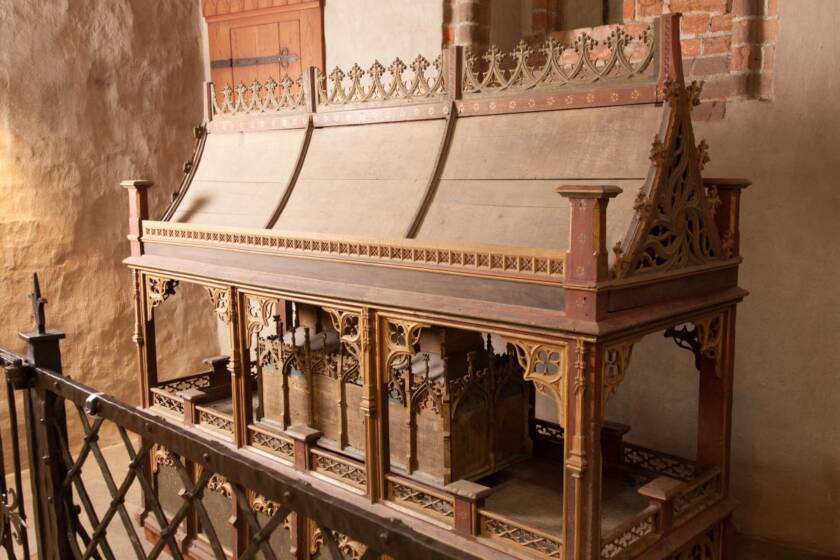
The wooden reliquary shrine of Blessed Bishop Hemming can still be seen in the Cathedral. Inside the chest shown in the accompanying image, a smaller casket was used to store relics—that is, sacred remains—and it has been dated to the early 15th century. It was most likely here that Bishop Hemming’s bones were transferred. The outer structure of the chest was probably made for the beatification ceremony. After the Reformation, the reliquary was no longer needed and was moved for storage behind locked doors within the stone walls of the sacristy. Thanks to this, it has, almost miraculously, survived several fires and has been preserved to this day.
King Gustav Vasa and the Beginning of the Swedish Reformation
During the reign of the ambitious King Gustav Vasa (1496–1560), Sweden was steered toward an early modern state. Crowned in 1523, the king strengthened taxation, reformed administration to consolidate royal and state power, established hereditary monarchy, and carried out the Reformation within his realm.
Gustav Vasa’s impact on the Church was profound. Already in the early years of his reign, he intervened in the collection of tithes, but an even greater shift was still to come. In 1517, Martin Luther had published his famous theses in Wittenberg, which eventually led to the rise of Lutheran, Protestant Christianity and its separation from the Catholic Church. In Sweden, the Riksdag of Västerås in 1527 approved the initiation of the Reformation and the reduction of Church property. Gustav Vasa broke away from papal authority and declared himself the head of the Church in his realm.
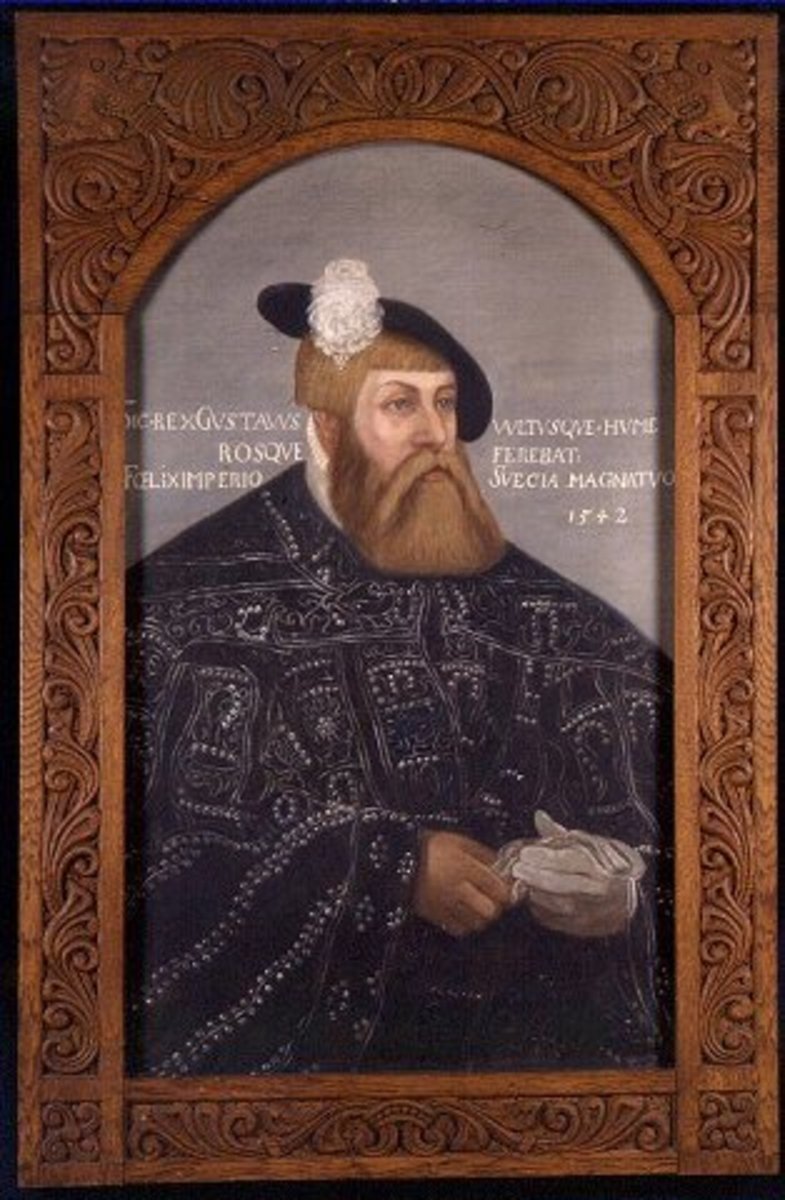
Gustav Vasa. Photo: Wikipedia
King Gustav Vasa’s reasons for adopting the new Lutheran doctrine were firmly rooted in political and economic considerations. By breaking away from papal authority, control over the Church shifted more directly into the king’s own hands. For example, the king gained the right to appoint new bishops. The Church’s power was further reduced, as bishops no longer had the right to participate in the Swedish Council of the Realm, which served as the king’s advisory body. Church property was extensively confiscated by the Crown: golden altar vessels were melted down, Church lands were seized, and the Church’s right to collect taxes was abolished.
Gustav Vasa also imposed a bell tax, which required every church to surrender its second-largest bell to be melted down to repay the king’s debts.
What, then, did the new Lutheran doctrine include? Martin Luther’s central criticisms had been directed at papal authority, the sale of indulgences, and in general those aspects of the Catholic Church that lacked a foundation in the Bible. In Lutheran teaching, the Word became central: all doctrine was to be based on the Bible. Furthermore, everyone should be able to read and hear the Word of God in their own native language.
Saints also had no place in Lutheran doctrine. In the Cathedral, too, altars dedicated to saints were removed, and reliquaries and statues were either confiscated by the Crown or moved to attics and storage spaces. Monasteries were dissolved, and the grand bishop’s castle at Kuusisto was ordered to be dismantled, its stones used in the expansion of Turku Castle. Lutheran priests were allowed to marry, giving rise to clerical families. The first married Finnish priest was Petrus Särkilahti, archdeacon of the cathedral chapter and a pioneer of the Reformation in Finland.
As a result of the Reformation, churches became poorer, education and care for the sick suffered, and the golden splendor that had accumulated in the Cathedral during the Catholic period disappeared. As if to mark the close of the medieval era, the Cathedral also burned in 1546, almost completely destroying its medieval wooden interior. However, the Reformation also laid the foundation for new forms of religious practice, the emergence of written Finnish, and, in the long term, the broader education of the population.
Reformation Bishop Mikael Agricola and the Birth of Written Finnish
Even in the Middle Ages, sermons had been delivered in Finnish, although the Mass itself was sung in Latin. According to Luther’s teachings, however, everyone should also be able to read about their faith in their own language. The Word thus became the central element of Lutheran worship and religious life. The first Swedish-language church service was held in the Cathedral in 1536.
While the Crown focused on confiscating Church property, the responsibility for establishing the new faith fell to the bishops. Mikael Agricola (Mikael Olavinpoika, c. 1510–1557) is regarded as the bishop of the Reformation in Finland. Born in Pernaja, Agricola traveled to Wittenberg after his ordination to continue his studies, where he became a student of Martin Luther. In Germany, Agricola gained firsthand knowledge of Lutheran teachings, which he brought back with him to Finland. In 1539, he became the rector of the Cathedral School.
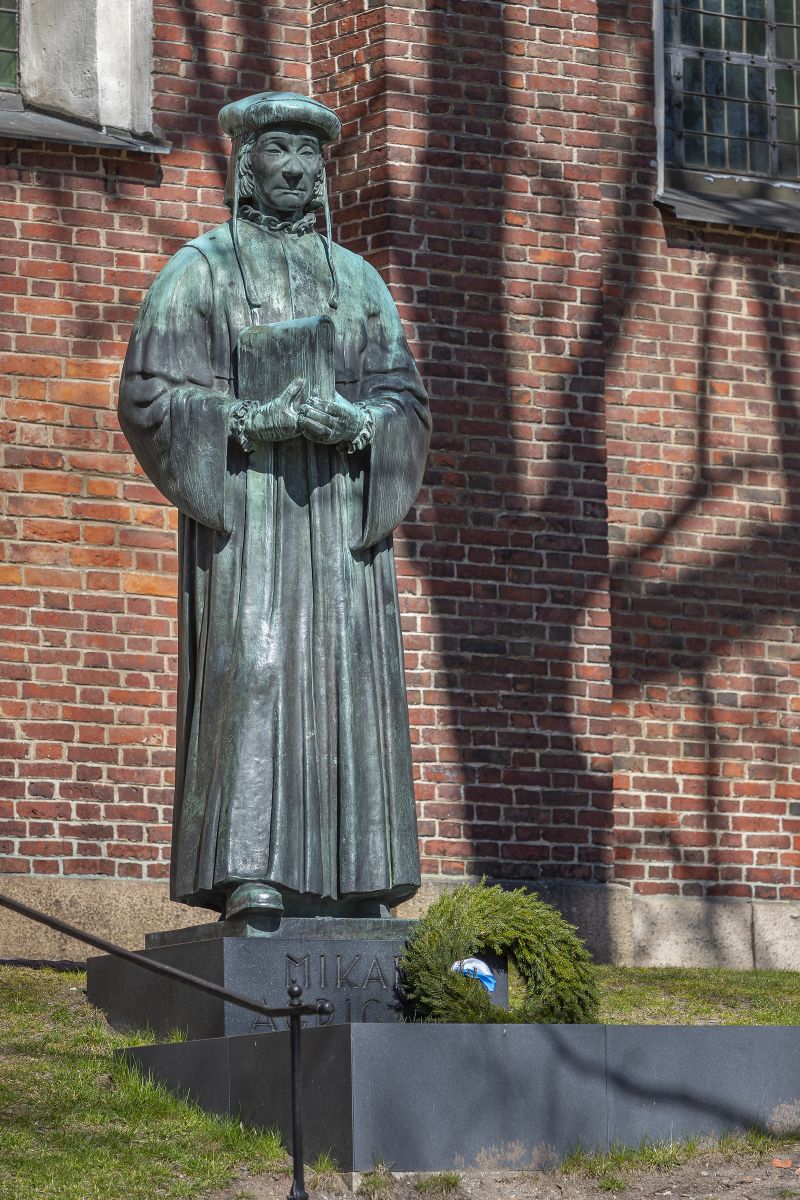
Finnish had, of course, been spoken in the country for centuries, but it had no established written form. Agricola therefore set out to develop a written Finnish language. His first work—and at the same time the first book in Finnish—Abckiria was published in 1543. The work contained both a catechism and an elementary primer. From Agricola’s pen came key ecclesiastical texts and translations that made it easier for priests to work and preach in Finnish. His translation of the New Testament was published in 1548. Agricola’s goal was to translate the entire Bible into Finnish, but this ambition was never realized due to a lack of funding.
In 1554, Gustav Vasa appointed Agricola as Bishop of the Diocese of Turku. During his episcopacy, Agricola established Lutheran teachings throughout the diocese. In 1557, he set out as Finland’s representative in a royal peace delegation to Moscow, as border disputes between Sweden and Russia had long caused unrest. On his return journey, Agricola died suddenly of illness and was buried in Vyborg along the way. His exact burial place is unknown, but he was most likely laid to rest beneath the floor of the old Cathedral of Vyborg. In 2007, the Chapel of the Holy Cross in the Cathedral was renamed the Agricola Chapel in his honor.
Hundreds of words coined by Agricola are still in use in Finnish today, such as omatunto (“conscience”) and hallitus (“government”).
Even after Agricola, the work of the Reformation continued under the bishops who followed him. From the Riksdag of Västerås onward, it took nearly seventy years for Lutheran doctrine to become firmly established in the country. It was not until the Church Assembly of Uppsala in 1593 that Lutheranism was formally adopted as the state religion of Sweden.
Paulus Juusten and the “Chronicle of the Bishops of Finland”
Another important Reformation-era bishop was Paulus Juusten (c. 1520–1575). Originally from Vyborg, Juusten, like Agricola, studied under Martin Luther in Wittenberg. He first served as Bishop of the Diocese of Vyborg from 1554 to 1563, and immediately afterward as Bishop of the Diocese of Turku until his death in 1575.
As a bishop, Juusten continued the work of the Reformation in Finland, but he is remembered even more significantly as Finland’s first known historian by name. His Latin work “Chronicon Episcoporum Finlandensium” (originally titled “Catalogus et Ordinaria Successio Episcoporum Finlandensium”, “A Catalogue and Orderly Succession of the Bishops of Finland”) was published in the 1570s.
Drawing on the notes of earlier bishops and recorded contemporary accounts, Juusten compiled information about the bishops who had led the Diocese of Turku before him. Based on these sources, he wrote biographies of the bishops, describing their significance and deeds within the diocese. In the preface to his work, Juusten also explained that the actions of earlier bishops should serve as both instruction and consolation for future bishops of the land.
Unlike many historians of his time, Juusten did not seek to create a grand, glorified past for his people, nor did he attempt to discredit the Catholic bishops of the Middle Ages. For this reason, the Chronicle of the Bishops of Finland remains one of the most important sources for the history of the Cathedral and the Diocese of Turku during the medieval and Reformation periods.
Juusten died in 1575. He was buried in the medieval main choir of the Cathedral, in front of what are now the front hymn boards, although his exact resting place is unknown.
Thus I have gathered the names and life accounts of the Bishops of Finland as our predecessors have earlier recorded them. Where they have ended, there have I continued, […]