
Art history tour
The artistic treasures of the Cathedral reflect centuries of history. This tour offers an introduction to the Cathedral’s ecclesiastical art. Each theme is illustrated with a specific example marked with a number on the map. Other details in the church related to the same theme are indicated on the map with symbols.
Medieval church art – symbolism
Turku Cathedral was extensively expanded during the Middle Ages, especially in the 15th century. The Cathedral functioned as a Catholic church for about two hundred years before becoming a Lutheran church in the early 16th century as a result of the Reformation.
When entering the medieval Catholic Cathedral, visitors would likely have seen decorative wall and ceiling paintings almost everywhere they looked. These paintings served two purposes: first, they decorated the church, which was very much in line with the character of Catholic churches. Second, they conveyed biblical stories, legends of saints, and teachings of the faith to a largely illiterate population.
The paintings in medieval churches are lime paintings, more specifically so-called secco paintings, executed on dry lime plaster surfaces. Churches were mainly painted using earth pigments, a mixture of limewater and minerals found in the ground. Blue was the most expensive color and therefore the rarest, reserved for the most important elements, such as the cloak of the Virgin Mary.
Church art was, and still is, full of symbolism. Many symbols originate from the Bible, but they also draw from imagery in ancient traditions and folk culture, which acquired new Christian meanings. The most recognizable symbol of Christianity is the cross. Symbols also reflect the unified culture of the Middle Ages: they spread throughout the Catholic world all the way to Finland.
In the Cathedral, many of these medieval paintings have been lost, especially due to fires. However, some have survived in certain areas. These are marked on the map with circular symbols.
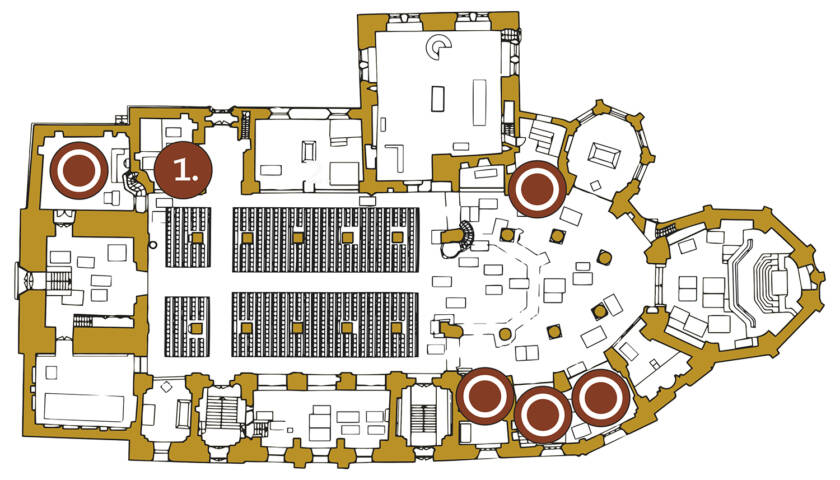
1. St. John’s Chapel (Kijk Chapel)
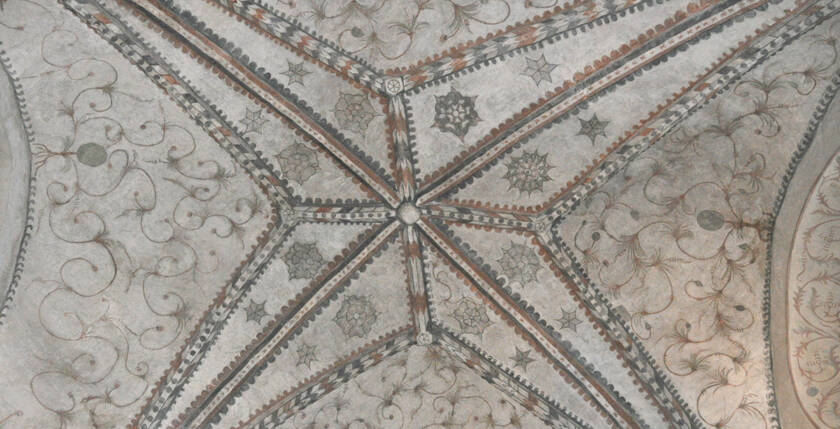
This chapel features decorative patterns and ornamentation. The lime paintings most likely date from the 1470s. The chapel contains abundant symbolism referring to the Virgin Mary, the oldest patron saint of the Cathedral.
On the ceiling, there are rosettes and stars. The white roses symbolize Mary’s virginity, her “purity,” while the red ones represent her love. The stars, in turn, refer to one of Mary’s titles: Stella maris, “Star of the Sea.” As a shining star, Mary was seen as guiding people toward Christ and calming the storms of life.
If the winds of temptation rise; if you are thrown upon the rocks of suffering, look to the star, call upon Mary […]
– Saint Bernard of Clairvaux (1090–1153)
The medieval wrought iron railing also conveys symbolic meanings. In the center of the flower on the gate there are symbolic motifs, and the railing features heraldic designs.
Medieval wall paintings can also be seen in the Cathedral, especially in the Agricola Chapel in the south nave. There, the ceiling is decorated with, among other things, four female saints and the Evangelists. There are also wall paintings in the passage next to the chapel. In addition, there are several places in the Cathedral where walls or vault ribs have been decorated with paintings. These can be seen, for example, in the north nave (on the same side as St. John’s Chapel, but toward the front of the church), as well as in the Sharpshooters’ Chapel. The ribs of the star vault in the entrance hall ceiling are also decorated. A keen observer may also notice largely faded decorations high up in the vaults of the main nave at the front of the Cathedral. There, between the star vaults, at least one coat of arms and rosettes can still be seen.
Interested? You might also visit: S:t Mary Church, where more imaginative medieval paintings have been preserved on the walls and ceilings than in the Cathedral. In literature: Anneli Kanto, Rottien pyhimys (Gummerus, 2021), a historical novel about the decoration of the Church of the Holy Cross in Hattula.
Coats of arms
Different countries, cities, and families often have their own coats of arms. Coats of arms consist of heraldic symbols—shapes, colors, and signs. Heraldry refers to the system and rules governing these symbols and their use. Heraldry, and thus coats of arms, developed in Europe in the 12th century, originally for the needs of knighthood. Knights clad in armor needed to be recognizable, and coats of arms helped with this by indicating at a glance who was who. Coats of arms were used on shields, in paintings, on seals, and on gravestones. In later periods, they were also used to decorate church walls. Nearly all the original heraldic decorations in the Cathedral were destroyed in the Great Fire of Turku in 1827.
The coats of arms found in the Cathedral are marked on the map with square symbols.
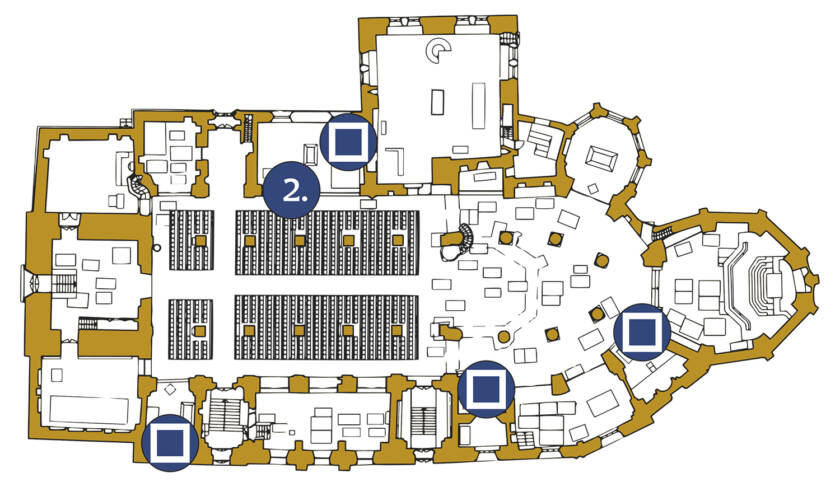
2. Tavast Chapel, also known as the Chapel of the Holy Body
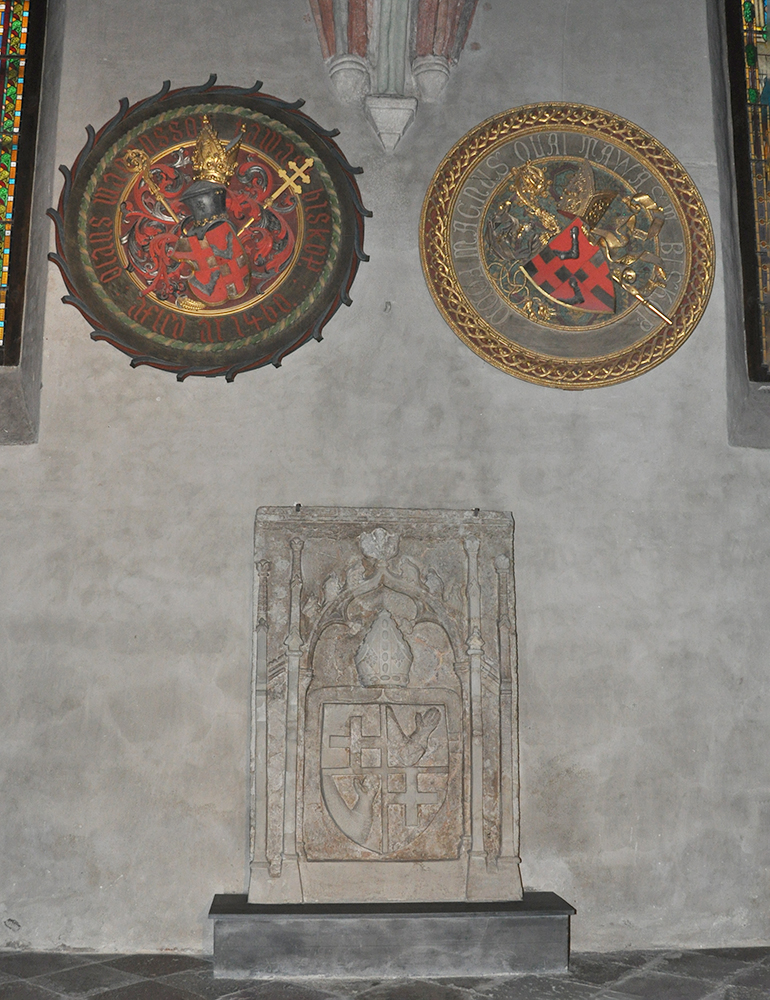
The walls of the chapel are adorned with decorative heraldic panels, with a coat of arms at the center, surrounded by the name of its owner and ornamental designs. These works were carved by the artist Magnus von Wright together with Italian ornamental sculptors in 1878. However, the families to whom the coats of arms belong date back to the Middle Ages. The earlier coats of arms were destroyed in the Great Fire of Turku in 1827, but the tradition was preserved, and some of the family coats of arms were recreated afterward.
Here you can see the coat of arms of Bishop Magnus II Tavast (c. 1360–1452). The coat of arms can also be seen on a tombstone leaning against the wall. The Tavast family is recognized by a bent, armored arm. The crosses, in turn, symbolize the bishopric as the emblem of the diocese.
On the other wall of the chapel, the coat of arms belongs to the Horn family, as the funerary monument commemorates Field Marshal Evert Horn (1585–1615). The name Horn comes from Swedish and translates into English the same way. Accordingly, the Horn family’s coat of arms features a horn, and the helmet ornament displays horns.
Additional coats of arms can also be found in the Cathedral behind the iron railing of the Tott Chapel in the front section, where the coat of arms of the Creutz family greets the visitor. On both sides of the stairs leading to the narrow chapel next to the Agricola Chapel, there are also coats of arms representing the Tigerstedt and Wallenstjerna families. The Tigerstedt coat of arms, naturally, features a tiger, while the Wallenstjerna arms display three stars and a horizontal band. In the rear part of the Cathedral, the coat of arms of the Stålhandske family appears in a stained glass window. However, due to a mistake by the artist (Swertschkoff), it depicts the wrong Stålhandske family.
The symbols in coats of arms could thus be based on a person’s surname or profession. What might your own coat of arms look like?
Stained glass
Stained glass windows are created either by painting or by assembling pieces. When an image is painted onto glass, it is fired so that the heat fixes the paint to the surface. Stained glass can also be made by assembling pieces of differently colored glass in a mosaic-like manner, joined together with lead strips. Already in medieval stone churches, especially those built in the Gothic style, windows were often decorated with colorful stained glass. The light filtered through them created a beautiful play of colors inside the church. With the Reformation, the use of stained glass decoration in churches declined. The ornamental stained glass windows of the Cathedral were painted by the Russian-Finnish artist Wladimir Swertschkoff (1821–1888). Swertschkoff donated the stained glass windows to the Cathedral in the 1870s. The locations of the stained glass windows are marked on the map with crown symbols.
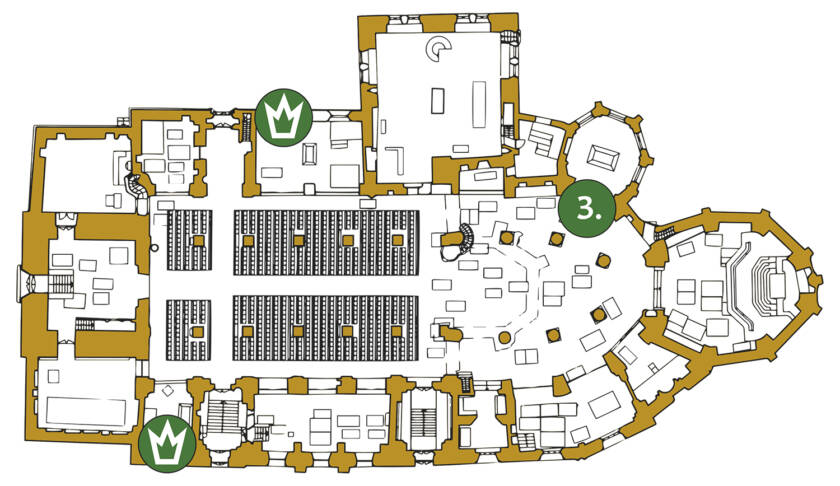
3. Kankais Chapel
In a black marble sarcophagus lies Queen Karin Månsdotter of Sweden (1550–1612), the wife of King Erik XIV. Behind the sarcophagus is a stained glass window depicting Karin Månsdotter renouncing her crown (1871). In the image, Karin, who was queen for only 87 days, bids farewell to Sweden, represented by a boy holding a crown. The queen is led down the steps of power by a figure representing Finland, a boy bearing the Finnish coat of arms. In the foreground, beneath a mourning veil, appears the old coat of arms of the city of Turku. Karin was just under 18 years old when her husband’s brother, John III, seized power and imprisoned the couple in 1568. After Erik’s death in 1577, Karin settled at Liuksiala Manor in Kangasala, where she lived for the rest of her life.
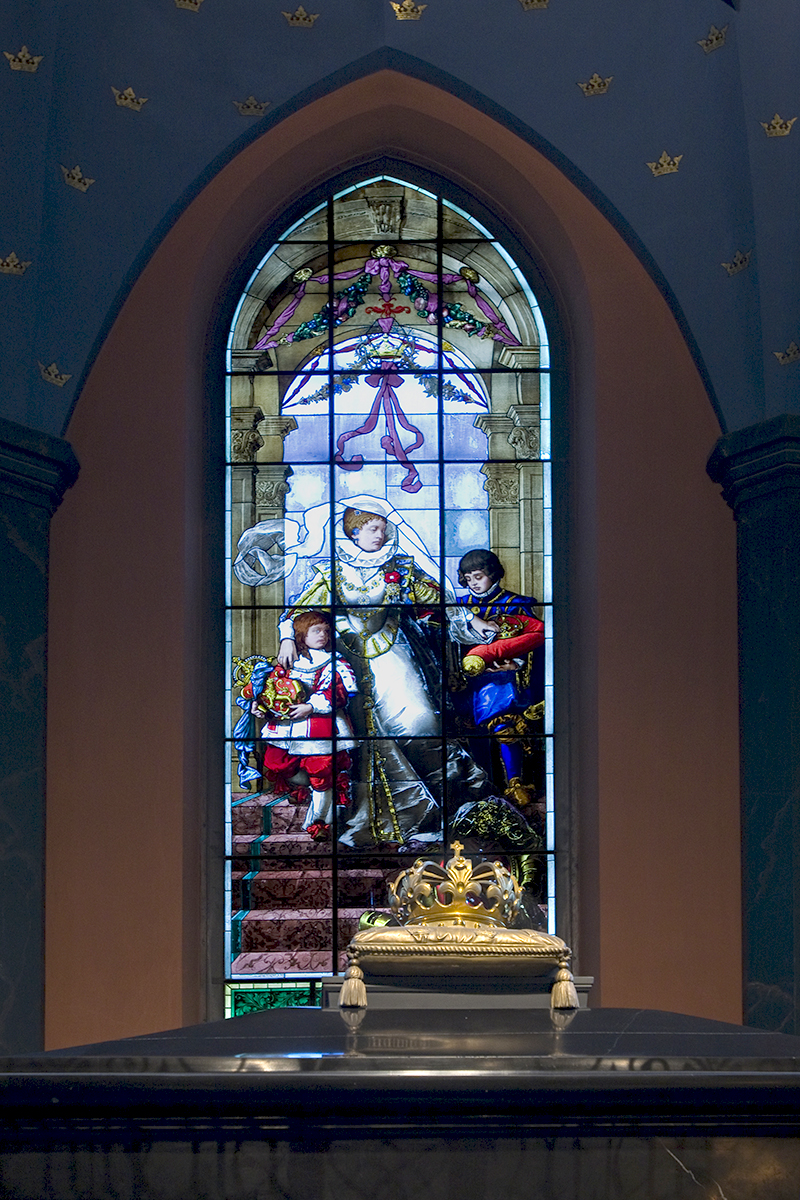
In two other stained glass windows in the same chapel, coats of arms are also depicted. On the left are the arms of the Kurck family and on the right those of the Horn family. These two families commissioned the chapel in the 1650s as a burial chapel for their families.
Swertschkoff also created stained glass for the Stålhandske Chapel and the Tavast chancel. The themes of the stained glass in the Tavast chancel include Christ’s suffering on the cross (with the Virgin Mary and the Apostle John traditionally at his side), in the lower section Faith, Hope, and Love, above the Holy Spirit in the form of a dove, and “Gustavus II Adolphus at the bier of Evert Horn.” When the stained glass was completed in 1875, it was the only publicly displayed artwork in the Swedish realm depicting Gustavus II Adolphus.
Altarpieces
In the Middle Ages, Turku Cathedral is estimated to have had over 40 side altars. These are no longer in use, but there are still several altars in the Cathedral today. Their locations are marked on the map with crosses.
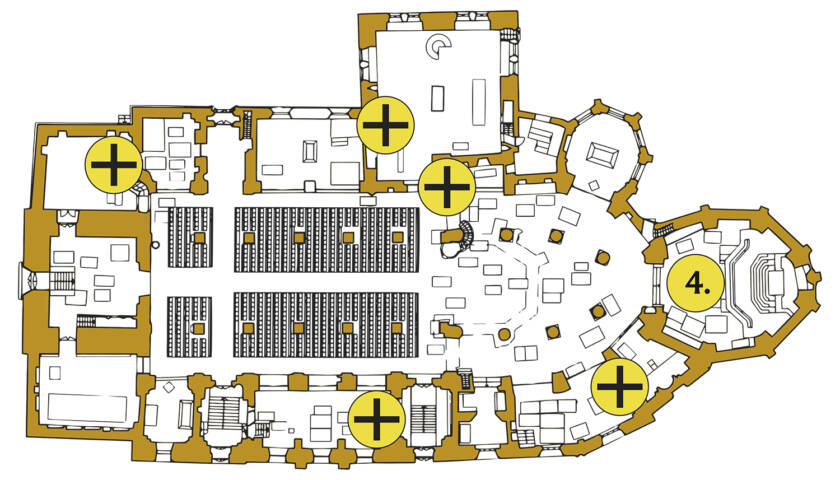
4. Main chancel
In churches, the largest and most prominent artwork is usually the altarpiece, which often draws the eye already upon entering. The altar is the place of Holy Communion, and traditionally it is placed along the eastern wall of the church, as the east is the direction of sunrise and resurrection. Likewise, the main chancel of the Cathedral is octagonal: the number symbolizes the day of resurrection and rebirth. The current appearance of the main chancel dates from after the Great Fire of Turku in 1827.
The altarpiece was painted by the prolific Swedish altarpiece artist Fredrik Westin in 1834. It depicts the Transfiguration of Christ, a scene described in the Bible and a common subject for altarpieces. The wooden altar frame was designed by the Swedish architect Carl Gustaf Blom, and executed by the Swedish sculptor Carl Wennerstöm.
After six days Jesus took with him Peter, James, and his brother John, and led them up a high mountain by themselves. There he was transfigured before them: his face shone like the sun, and his clothes became as white as the light. Suddenly, Moses and Elijah appeared to them, talking with Jesus. Peter said to Jesus, “Lord, it is good for us to be here. If you wish, I will put up three shelters—one for you, one for Moses and one for Elijah.” While he was still speaking, a bright cloud covered them, and a voice from the cloud said, “This is my Son, whom I love; with him I am well pleased. Listen to him!”
After six days Jesus took with him Peter, James, and his brother John, and led them up a high mountain by themselves. There he was transfigured before them: his face shone like the sun, and his clothes became as white as the light. Suddenly, Moses and Elijah appeared to them, talking with Jesus. Peter said to Jesus, “Lord, it is good for us to be here. If you wish, I will put up three shelters—one for you, one for Moses and one for Elijah.” While he was still speaking, a bright cloud covered them, and a voice from the cloud said, “This is my Son, whom I love; with him I am well pleased. Listen to him!”
Matthew 17:1–5
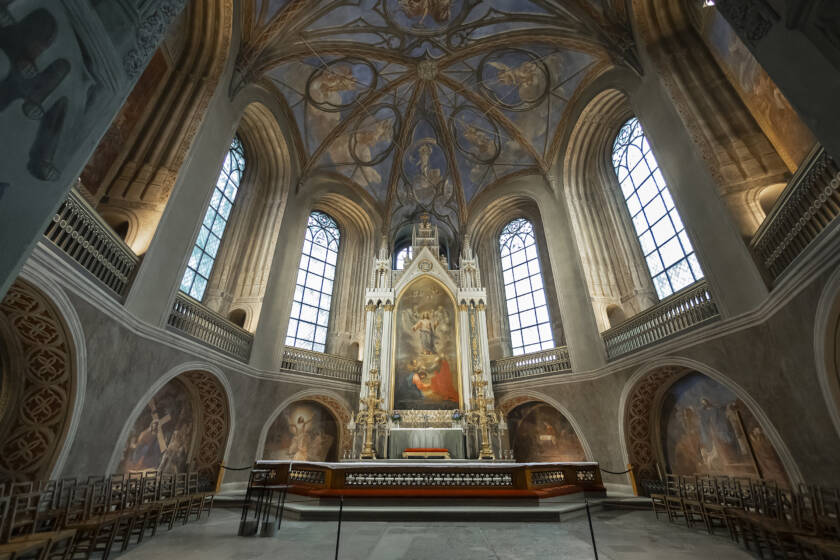
The walls and ceiling around the altar are adorned with Finland’s first fresco paintings. Frescoes are painted directly onto a moist wall surface, and as the paint dries, it binds to the wall. Fresco painting is a technique thousands of years old. The word “fresco” comes from the Italian word fresco, meaning fresh.
The frescoes were painted by Robert Wilhelm Ekman (1808–1873) in the mid-19th century. Ekman has been called the father of Finnish painting and is considered an early representative of national romanticism. The frescoes along the walls depict scenes from the life of Jesus: his birth, the raising of Lazarus, the Last Supper, prayer in Gethsemane, the Way of the Cross, and the Resurrection. The ceiling fresco portrays angels inspired by the Book of Revelation, representing the wonders of heaven.
National romantic artists drew inspiration from key moments in the history of their nation. Ekman’s other works also depict figures from the Finnish national epic Kalevala as well as idealized scenes of peaceful rural life. His national romantic style can be seen in the Cathedral both in his painting technique and in two historical scenes painted above the frescoes.
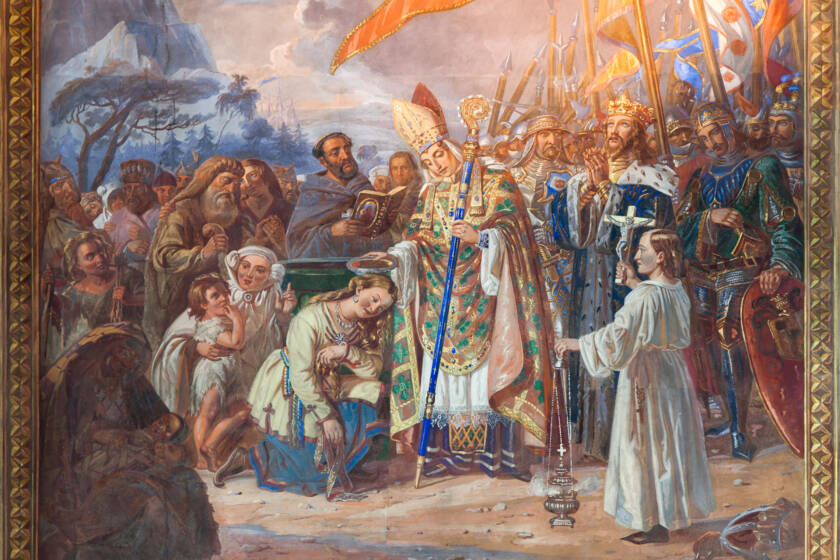
In the first of these, on the south side when viewed from the altar (to the left), Bishop Henry is shown baptizing Finns at the Kupittaa spring. The First Crusade in the 1150s brought Bishop Henry and King Eric of Sweden to Finland, and for a long time they were depicted in legend as arriving with a military escort. Later, the whole idea of such a crusade has been questioned, but at the time when the frescoes were painted, the legend was still widely accepted. In the painting, the bishop baptizes a woman dressed in ancient attire. On the far left, behind a bearded man, lurks Lalli, the killer of Bishop Henry, with an axe on his shoulder.
In the second painting, located to the upper right when viewed from the altar, Bishop Mikael Agricola of the Cathedral (c. 1510–1557) presents a newly completed Finnish-language Bible to King Gustav Vasa of Sweden. In the foreground on the left, a lute can be seen, Gustav Vasa’s favorite instrument.
The Christianization of Finland and the development of the Finnish written language are milestone events that clearly inspired Ekman’s imagination. However, neither of these depictions fully corresponds to historical reality. The pair associated with the First Crusade, Erik and Henry, never arrived in Kupittaa in Turku, but operated further north. Likewise, Mikael Agricola never presented his translation work to the king. Agricola translated the New Testament into Finnish in 1548, but the first complete Finnish Bible was not published until nearly a century later, in 1642.
An altar also traditionally includes a crucifix. The altars marked on the map each feature different crucifixes. In the south nave of the Cathedral, toward the bottom of the map, is the Mayor’s Chancel, where a crucifix from the 15th century hangs on the wall. By the chapel window, there is also a small and rather worn crucifix dating from the 14th century.
The art history tour has been created by Henna Ala-Lehtimäki.