
15th Century – The Golden Age of the Middle Ages
The “golden” Middle Ages were truly golden for the Cathedral: it was wealthy and prosperous, and the bishops further increased both its power and its assets. The Cathedral was expanded with side chapels throughout the 15th century.
In the 15th century, the Cathedral underwent extensive expansion. During the High Middle Ages, there was constant activity in the church from sunrise to sunset. After entering through the porch on the southern side and making the sign of the cross with holy water before stepping into the nave, visitors could pause in a multisensory environment. The noise of the city faded within the cool stone walls, and the soaring ceiling was a marvel to people accustomed to living in small cottages. Colored light filtered through stained-glass windows onto walls covered with paintings, incense filled the air, and the Latin chants of the Mass resounded.
As a city, Turku had expanded, but on the opposite side of the river it included only the Aninkaistenmäki area. The Pennisilta (“Penny Bridge”), the first bridge across the Aura River, was built in 1414. Legal and administrative life also developed further; for example, the Turku District Court was established at the beginning of the century. During this period, the population of Turku rose to an estimated 2,000–3,000 inhabitants.
Side Chapels for Saints – The Expansion of the Cathedral
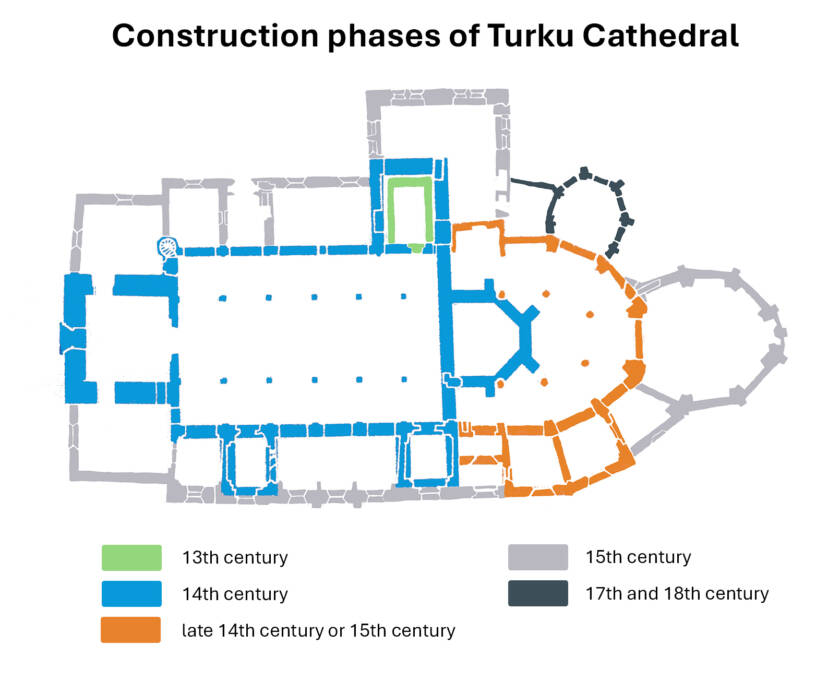
Our knowledge of the Cathedral’s construction phases is based primarily on archaeological excavations led by Juhani Rinne in the 1920s, as well as some later studies. The results have varied considerably, meaning that it is still not entirely certain exactly when the different expansions of the Cathedral took place. Further research is therefore still needed.
However, according to various estimates, as early as the late 14th century—and at the latest by the early 15th century—the eastern end of the Cathedral was extended with a new main choir, nearly doubling the length of the nave. The new choir spanned the full width of the three-aisled nave. The altar was placed within the octagonal pillars rising at the eastern end of the Cathedral and was enclosed by a wooden choir screen. The congregation was not permitted to enter the area inside the choir screen; for example, Holy Communion was distributed in front of it, at a lay altar on the side of the nave. Within the choir, the Mass was celebrated and wedding couples were blessed. Beneath the choir floor, many priests found their final resting place. Around the same time, the sacristy was expanded and the church tower was raised.
As one walks around the Cathedral, one’s attention is drawn to the wrought-iron screens and the side chapels located within them. Numerous side chapels were built during the 15th century, mainly to house altars dedicated to saints. The oldest of these is the Chapel of Saint Catherine, constructed at the same time as the expansion of the main choir. In the late 15th century, it was combined with the adjacent Chapel of Saint Bartholomew and renamed the Chapel of the Holy Cross (now known as the Agricola Chapel).
In the early 15th century, the Mayor’s Choir, All Souls Chapel (Stålhandske Chapel), and the Chapel of the Corpus Christi (Tavast Chapel) were also built. In the middle of the century, the Cathedral was expanded with the Chapel of Saint John (Kijk Chapel) and the St Ursula Chapel. At the end of the 15th century, the choir of the present main altar, the octagonal Chapel of All Saints, was completed.
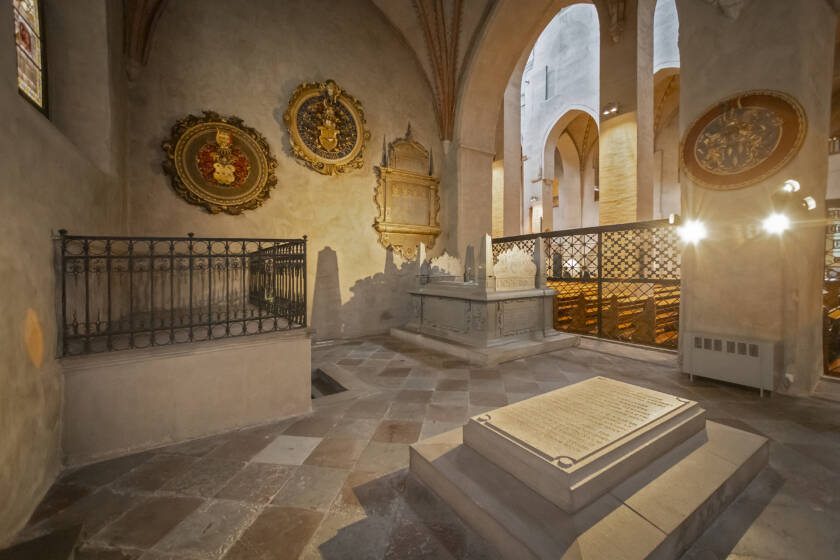
Corpus Christi Chapel. Photo: Timo Jakonen
One of the largest chapels in the Cathedral—Corpus Christi Chapel (pictured)—can be dated with particular certainty. An inscription on its wrought-iron screen reads in Latin: “ano dni mcdxxv magnus olai epus fecit fiei hop,” which can be translated roughly as: “In the year of the Lord 1425, Bishop Magnus Olai made this work.” This iron screen from 1425 is also the oldest dated work of art in Finland and the longest surviving medieval iron screen in the Nordic countries.
We can thank Bishop Magnus Olai, also known as Maunu II Tavast, who commissioned both the iron screen and the chapel, for many of the Cathedral’s expansions. He also acquired numerous relics and riches for the Cathedral, strengthening its self-sufficiency. During his time, the Cathedral reached the height of its medieval golden age.
Magnus et re et nomine – Bishop Maunu II Tavast, also known as Magnus Olai, is said to have been great both in reality and in name.
The construction of side chapels and ongoing expansions gradually moved the church’s outer windows farther away from the nave. As the nave became darker, it became necessary to raise the central aisle higher to bring more light into the church through clerestory windows. Records preserved in account books reveal that in 1466, payment was made for this elevation work to Peter, a master mason from Kemiö, and his three assistants. Since then, the vaults of the central aisle have arched at a height of 24 meters. Architecturally, a church in which the central nave rises higher than the side aisles is called a basilica. The Cathedral is in fact the only medieval basilica in Finland.
Around the same time, in the late 15th century, the present choir of the main altar was also constructed. At that time, the space was known as the All Saints Chapel, and it housed the most important relics. The current frescoes of the main altar are painted in the niches that were originally intended for these relics.
From the 1470s onward, the Cathedral was surrounded by an outer wall. Its purpose was to separate the church and the churchyard—used as a burial ground—from the surrounding area, thus marking the boundary between the sacred and the secular. It has also been suggested that the wall served as a symbol of authority and had a defensive function. The wall was about 400 meters long, nearly four meters high, and in places as much as two meters thick. A roof ridge ran along its top. Initially, the wall had five (later six) gates, and several buildings were attached to it, including the Cathedral School and the chapter house.
Many spells and folk beliefs were associated with the wall surrounding the church. For example, good luck in fishing could be obtained by casting a line over the wall and catching skulls that had risen from the burial ground with the frost.
Saints as Protectors and Intercessors
During the Catholic era, the cult of saints was strongly present in the Cathedral as well. Saints are servants and friends of God who are venerated in the Church and to whom people may address intercessory prayers. For many medieval Christians, saints provided comfort and help, but the stories told about them also served as examples of the many different ways a person could dedicate their life to God. The most important saint throughout the Catholic Church was—and still is—the Virgin Mary.
Saints were believed to perform miracles either during their lifetime or after their death, for example by answering prayers made in their name. Accounts of such events were recorded in hagiographies—biographical texts about saints—which spread across Europe through the Church and became widely known among the people. Important saints included early Christians who had suffered martyrdom. Saints remain an important part of both the Catholic and Orthodox Churches, and their influence is also visible in Finnish culture. For instance, the tradition of celebrating name days is based on the medieval calendar of saints.
It is estimated that the Cathedral had as many as 42 altars dedicated to saints at its peak. These were placed throughout the nave, especially in the side chapels, and were used for observing saints’ feast days and commemorations. Establishing an altar required sufficient income, as each altar had its own staff. Altars were often founded through donations, such as a prebend (an endowed source of income). An altar was also regarded as the burial place of a saint and therefore required a relic. A relic was often a bone of the saint, believed to retain holiness even after death. Relics were exchanged between churches, and bishops could also bring them back from pilgrimages.
Guilds were also established to maintain the cult of saints; in Turku, there are known to have been at least six such guilds. The task of a guild was to maintain a saint’s altar and take care of the ceremonies performed there. Saints were very tangible figures in religious life: for every ailment, distress, or profession, there was a specific saint to whom one could turn in intercessory prayer. If a request was fulfilled, it was customary to undertake a pilgrimage to the saint’s tomb—that is, to their altar—as an act of thanksgiving. The significance of saints in Finland gradually declined with the Reformation.
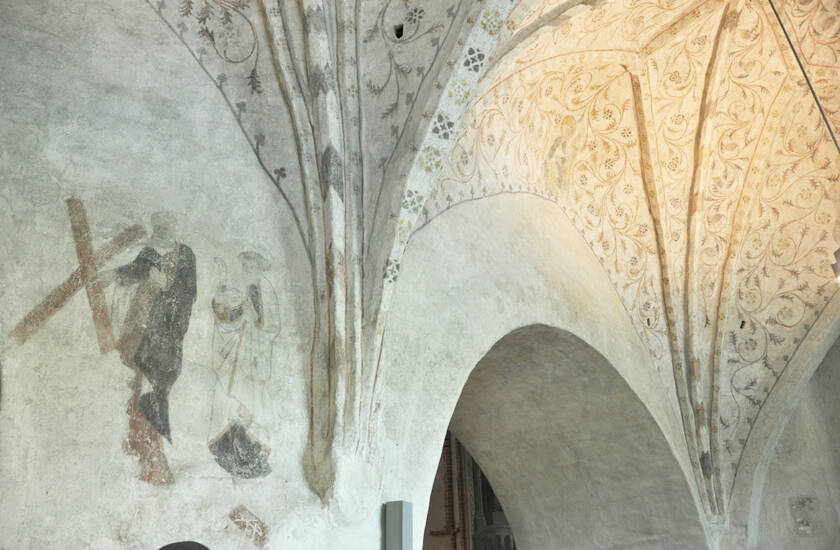
Those interested in the Middle Ages should, in the Cathedral, make their way especially to the Chapel of the Holy Cross, now known as the Agricola Chapel. The walls and ceilings of the chapel are decorated with frescoes from the late 15th century, some of which have fortunately been preserved in places in the Cathedral. On the eastern side of the ceiling are four female saints, while the western vaults feature the symbols of the authors of the Gospels. The walls depict saints, a donor couple supporting a church, and a knight bearing an unidentified coat of arms. In the image on the left are Saint Andrew and Saint Bartholomew, and in the background on the ceiling is Saint Barbara.
The Wealthiest and Most Powerful in Finland – Bishops of the Middle Ages
During the Catholic Middle Ages, the bishop operating from the Cathedral was among the most powerful figures in Finland. Bishops were also among the most educated men, having received their master’s degrees at universities across Europe. The Diocese of Turku was the only diocese in the country until the mid-16th century, meaning that all ecclesiastical administration in what is now Finland was directed from Turku under the authority of the bishop. By the end of the Middle Ages, the Bishop of Turku oversaw as many as one hundred parishes.
The Bishop of the Diocese of Turku answered to the Archbishop of Uppsala, as well as to the cardinals and the Pope in Rome. However, the archbishops of Uppsala rarely visited Finland to oversee diocesan affairs, which allowed the bishop considerable independence—provided that he adhered to the rights and duties defined by canon law.
In the Middle Ages, bishops were elected through a formal episcopal election in which voting rights were held by the cathedral chapter. The cathedral chapter, established as early as 1276, was responsible not only for electing the bishop but also for managing the Cathedral’s finances and administration. After being elected, the bishop sought confirmation and consecration from the Pope; until the late Middle Ages, this required a journey to Rome. Later on, however, a representative would make the journey, and the consecration was performed by the Archbishop of Uppsala.
The bishop’s duties included ordaining new priests, deacons, and other church officials, administering the sacrament of confirmation, and consecrating new churches and cemeteries. The bishop also exercised administrative and judicial authority, overseeing, among other things, disciplinary matters concerning the clergy, and conducting episcopal inspections in parishes. The bishop also held political power: in the Middle Ages, he had the right to participate in the Council of the Realm of Sweden, which functioned as an advisory body to the king.
The bishop was also a lord of a castle. A bishop’s castle was built in Kuusisto, where the bishop is known to have resided by at least 1295. In the 14th century, the castle was constructed in stone and expanded. Situated on an island, it also served as a significant defensive stronghold. During the time of Bishop Maunu II Tavast (bishop from 1412 to 1450), Kuusisto Castle experienced its golden age: it was expanded and became an impressive and wealthy economic center. After the Reformation, King Gustav Vasa ordered the castle to be dismantled, and its bricks were later used, among other things, in the expansion of Turku Castle.
From the castle, the bishop maintained and increased his wealth, which was derived from the income of the episcopal estate (piispanpöytä). This referred to the official property at the bishop’s disposal, including real estate, manors, and farms, along with their revenues. The bishop also had the right to collect taxes and to receive hospitality (known as procuration) during official visits.
In total, there were 12 bishops in the Diocese of Turku during the Middle Ages, the first being Saint Henry. Most of these medieval bishops are buried in the Cathedral. Today, two bishops are based in Turku: the Archbishop and the Bishop of the Diocese of Turku.
Missale Aboense
Although Finland did not gain its first printing press until 1642, a written culture had already existed in the country since the Middle Ages. Bishops, as well as parish priests, maintained personal book collections, and the Cathedral also had its own library. Many priests educated at the Cathedral School continued their studies at universities abroad, returning home with books from across Europe. Since Latin was the common language of the Catholic Church, the transmission of liturgical tradition through books was relatively easy. From the 15th century onward, the availability of books increased further with the development of printing technology in Germany, which significantly accelerated book production.
The first book printed specifically for Finland is Missale Aboense, or the Missal of Turku. It is also the only Finnish incunabulum—that is, a book printed before the year 1501. Missale Aboense was printed in Lübeck in 1488. The missal was commissioned by the then Bishop of the Cathedral, Konrad Bitz, and the dean Maunu Särkilahti, who succeeded Bitz as bishop.
The Latin-language Missale Aboense contained masses and prayers needed for church services and used throughout the Catholic world. Its contents were strongly based on Dominican liturgy—appropriate, as Turku also had its own Dominican convent of St. Olaf. However, the missal also included texts created for local use, such as Turku-specific liturgical texts that were not part of the standard Dominican tradition. In addition, the beginning of the book contained a calendar of saints for the Diocese of Turku. An estimated couple of hundred copies of the book were printed on parchment and paper and distributed to parish priests.
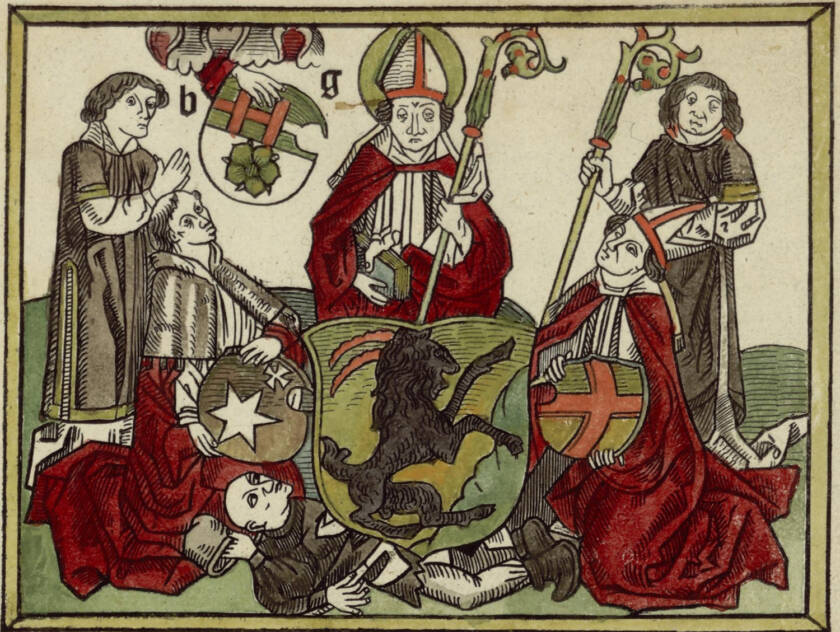
The woodcut on the opening page of Missale Aboense (pictured) refers to the Diocese of Turku. At the center of the image, Saint Henry is shown trampling his killer, Lalli. To Saint Henry’s right stands Bishop Konrad Bitz, wearing a mitre, and to his left is the dean Maunu Särkilahti. In the upper left corner appear the initials and coat of arms of the printer Bartholomeus Ghotan.
A few copies of Missale Aboense have survived to the present day, but all of them are incomplete. Digitized images of the surviving copies can be downloaded and viewed in the National Library’s Doria archive via the link.