
Bishop Henry’s tour
On this tour, you will get to know the Cathedral’s own patron saint, Saint Henry. The events of his life are set in the 12th century, in the 1150s.
If you wish, you can make use of the Cathedral’s virtual tour. Move from one stop to another and use it to explore Finnish history, religion, and folklore.
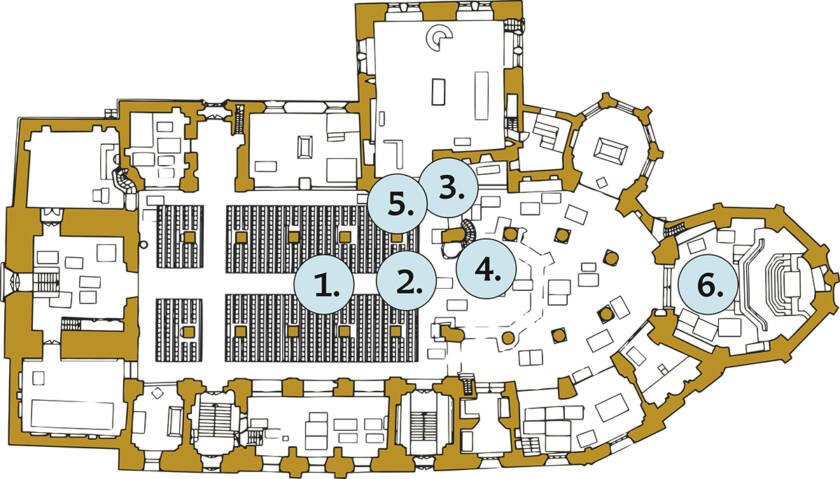
Station 1: The beginning
At the beginning of the 11th century, Finland was a forested and sparsely populated land. We did not really belong to any state. To our west was Sweden, ruled by a king, and to the east of Karelia was a republic called Novgorod. The Finns lived here in tribes, each with its own chieftains. We do not have written historical sources from before the 13th century. However, archaeologists have made burial and artifact discoveries from earlier periods, which provide us with information about Finnish ways of life during these early, poorly documented centuries.
Something was already known about Christianity at that time—perhaps traders who visited the region brought news of this new and different religion from the Mediterranean area. It is known that by the early 11th century, there were already some small Christian communities here. Archaeological findings even suggest that there may have been signs of the Christian religion in Finland as early as the 6th century.
Most Finns, however, believed in a nature-based religion, and their gods were closely connected to nature and weather. For example, there was Tapio, the god of the forest, and Ahti and Vellamo, the lord and lady of the waters. In 1551, Mikael Agricola published a poetic list of Finnish “pagan gods” from the time before Christianity, based on his own research.
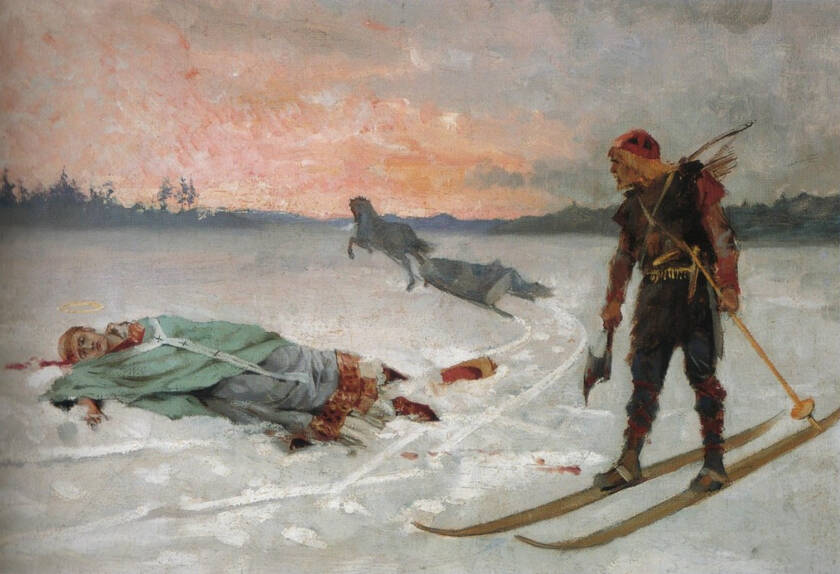
Albert Edelfelt: Bishop Henry and Lalli. Image: Wikipedia
Henry and Lalli
Our image of Bishop Henry and Lalli, his killer, is based on two separate recorded stories: the Legend of Saint Henry and the Ballad of Bishop Henry’s Death. The former was written in Latin in the late 13th century, while the latter is in the vernacular and was recorded much later, in the 17th century.
The story taught to Finns tells that the Swedish king Erik came to Finland together with Bishop Henry of Uppsala around the year 1150, accompanied by an army. The purpose of the king’s expedition was to bring the Finns under his rule, while Bishop Henry was to convert the “pagan people” living here to Christianity, as the legend describes. This expedition has later been referred to as the First Crusade to Finland.
According to the story, this mission succeeded. King Erik returned to Sweden, but Bishop Henry remained in Finland to shepherd the newly converted people. He is therefore regarded as the first bishop of Finland. The following winter, however, he reproached a certain man for a crime, which led to the man—named Lalli—killing Bishop Henry on the ice of Lake Köyliö.
This story is thus based on two different accounts. The first is the Legend of Saint Henry, a Latin text from the late 13th century, written about 130 years after the events it describes. It has been suggested that it may have been commissioned by a bishop of that time, as part of a church initiative to produce an official biography of a bishop who had died a martyr’s death. The Legend of Saint Henry contains few detailed descriptions; it is more narrative in tone and serves to justify King Erik’s expedition to Finland. It also praises the sanctity of Bishop Henry after his death. The legend is divided into two parts: the vita, which describes the experiences of Erik and Henry in Finland, and the miracula, which focuses on the miracles attributed to Saint Henry—eleven in total. The first of these is the punishment of Lalli: after the murder, the bishop’s mitre or hat taken by Lalli causes him to lose his hair and scalp.
The second, and much more detailed account, is the vernacular Ballad of Bishop Henry’s Death, written much later in the 17th century. It is only in this ballad that the killer is given the name Lalli and the events are described more precisely. According to the ballad, Lalli killed Bishop Henry with an axe on the ice of Lake Köyliö.
Both stories are highly didactic, portraying the struggle between good and evil, which was typical of spiritual literature of that time. First, the evil pagan Lalli kills the good, educated, and Christian bishop. But evil receives its punishment: Lalli suffers for his deed. In medieval art, Saint Henry is often depicted trampling Lalli, who lies beneath him with a bloodied head.
It is important, however, to recognize Henry’s significance not only for Christianity in Finland but also for Finnish culture and education. The Latin Legend of Saint Henry is the earliest example of written history in Finland and forms the oldest root of Finnish literature. Although the historical accuracy of the story has been questioned, it remains the starting point of Finnish ecclesiastical historiography. Through the Legend of Saint Henry, Finns were connected to the Western Catholic Church, and Finland gained its own national saint among the wider community of saints. In this way, Finland became part of Western European culture.
And what of Lalli’s role in the story? In the Middle Ages, and even after the Reformation, he was still seen as the villainous murderer who is punished for his crime. However, by the 19th century, as nationalism began to rise in Finland and dreams of independence emerged, Lalli also began to be viewed in a more positive light. He was seen as someone who dared to defy a foreign representative of an alien culture. The painter Albert Edelfelt, in his 1877 painting, portrayed Henry as a somewhat helpless foreigner, unable even to dress properly for the Finnish winter. Lalli, on the other hand, appears as a broad-shouldered Finnish figure, standing on skis with an axe in hand—a strong man who did not tolerate an outsider spreading his message. This nationalist interpretation has continued into independent Finland. A statue of Lalli was even erected in Köyliö in the 1980s.
Of the figures in the story, only King Erik has been confirmed to be a historical person. The existence of Bishop Henry is uncertain. It is believed that the story contains a historical core, but who exactly the person accompanying Erik was, and what his true story might have been, remains unclear even in modern research of the 21st century.
The legendary Bishop Henry may have been almost too perfect as a medieval martyr: he was a bishop, missionary, crusader, and martyr all at once. It is possible that Henry is a fictional figure, but scholars hold differing views on this matter.
Station 2: The altar of the patron saint
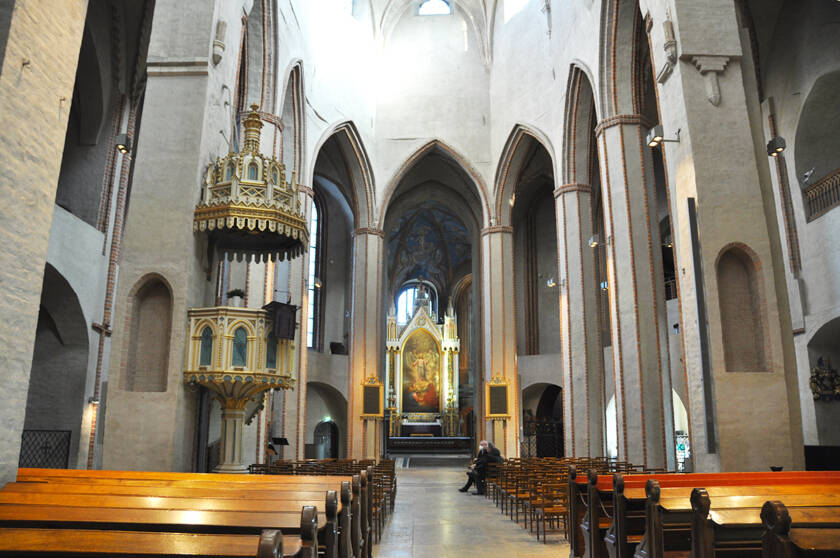
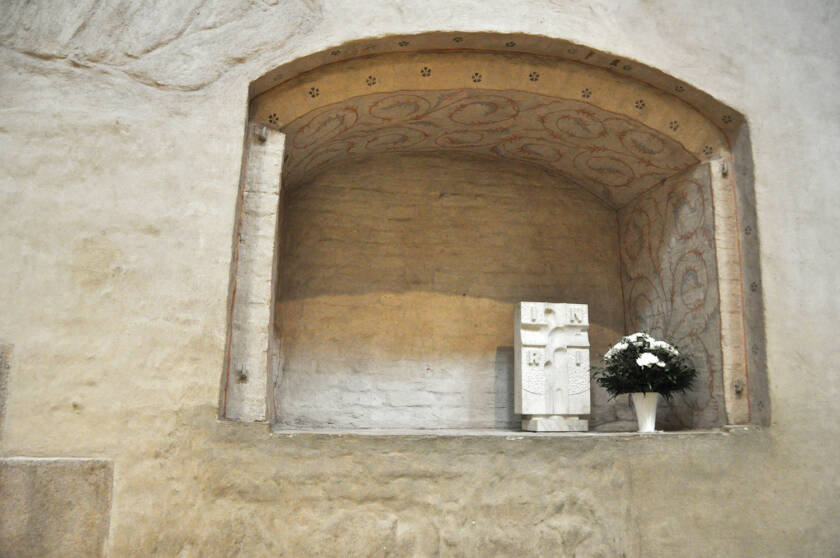
If you are now standing by the pillar with the pulpit and facing the main altar, you will see a niche in the pillar in front of you. It is assumed that this niche once served as the altar of Saint Henry. As you continue to face the altar, on the right side of the nave you will see a similar pillar with a similar altar niche. It is known that this was the altar of the Virgin Mary. Saint Henry and the Virgin Mary were the first patron saints of this Cathedral.
The first day of the Cathedral’s consecration celebrations was 17 June 1300. On that day, this church became the bishop’s home church, that is, a Cathedral. The word “cathedral” originally refers to a home church and comes from the Latin word domus, although in Finnish it has taken on its current form due to a historical translation error.
The church that stood on this site, much smaller than the present one, was consecrated as a Cathedral in 1300. There had already been a cathedral beforehand: the bishop’s seat had previously been located at Koroinen, and before that in Nousiainen. Magnus I, who was bishop in 1300, was already the eighth bishop in Finland. A papal letter from 1259 confirms that the Diocese of Turku was already an independent and organized part of the Western Catholic Church at that time.
The Pope and the leadership of the Western Catholic Church had declared the year 1300 a special jubilee year. Many pilgrims traveled, for example, to Rome to celebrate it. Here in Finland, Bishop Magnus I decided that the jubilee year would be marked by consecrating the church on this site as a new Cathedral. Some degree of urban planning had already begun, and a town was being established in this area, making it a suitable location for the bishop’s seat. It is believed that the consecration celebrations of Turku Cathedral took place on 17–18 June.
The church building at the time was very small and modest compared to the imposing structure of today. It was still a wooden church, with only the sacristy built of stone. Nevertheless, it was given grand consecration celebrations, and the bishop’s seat was moved here from Koroinen, a few kilometers away. This became the principal church of the Diocese of Turku and, at the time, of all Finland.
The two-day consecration celebrations that began on 17 June 1300 were something unprecedented in Finland at the time. Large numbers of people gathered in Turku to celebrate. There were crowds and even market activity around the church. The wooden church hall was filled with people as Bishop Magnus I consecrated the Cathedral. Holy water was sprinkled, fragrant incense was burned, and twelve consecration crosses were drawn on the walls with holy oil. Beautiful medieval hymns resounded in the church. Light filtered into the space in colored hues through stained glass windows. This first day served as a prelude to the second great day of the celebration, when the earthly remains of Saint Henry were brought to the site. More about that follows.
The Cathedral’s other main patron altar was dedicated to the Virgin Mary. In the Catholic Church, the Virgin Mary holds a central place as the mother of Jesus. She is regarded as a saint for all humanity. In addition to the Virgin Mary, each church is given its own patron saint or saints.
Station 3: The altar of Saint Henry and Saint Eric
You are now standing at the altar of Saint Henry and Saint Eric.
Bishop Henry became a saint—Saint Henry—when he met a martyr’s death in Finland on the ice of Lake Köyliö. Henry arrived in Finland sometime in the 1150s, traveling here together with King Erik IX of Sweden. This journey has later been referred to as the First Crusade to Finland. King Erik was also later canonized as a saint, known as Saint Eric. Bishop Henry is regarded as the first bishop of Finland, and he became the patron saint of Turku Cathedral and, at the same time, the national saint of Finland.
The Legend of Saint Henry tells how King Erik of Sweden set out with his army and Bishop Henry of Uppsala and arrived in Finland by ship. In the legend, the Finns are described as a blind and cruel pagan people who often caused serious harm to the people of Sweden. For this reason, the king came here with his army and Bishop Henry. The legend continues: “When he (Erik) had forcibly brought them (the Finns) under Christianity and his own rule, baptized a great number of them, and established churches in those regions, he returned to Sweden as a glorious victor.” Bishop Henry remained in Finland.
Bishop Henry is considered the first bishop of Finland, but already the following winter he met his death. According to the story, he encountered a Finnish man who killed him. Because Henry died for his faith, he was regarded, according to the beliefs of that time, as a martyr and a saint. Thus Bishop Henry became Saint Henry.
There are no written records from that period itself. Only in the late 13th century was the Latin Legend of Saint Henry written about these events. It was most likely written here in Turku, although the author is unknown. It was not until the 17th century that the Ballad of Bishop Henry’s Death was recorded. This is a vernacular account of his life and deeds. In this ballad, the killer is named Lalli, and the place of death is identified as the ice of Lake Köyliö.
There is no certain evidence that Bishop Henry or his killer Lalli were real historical figures. However, it is believed that some historical core lies behind the legend. Even though there are no contemporary records of Erik either, it has been possible to confirm that King Erik IX was a real historical figure. A chronicle about Erik was written in Sweden even before the Legend of Saint Henry. King Erik also died a martyr’s death around 1160 in Stockholm and became Saint Eric. Around the year 1400, approximately one hundred years after the consecration celebrations, Saint Eric became the third patron saint of the Cathedral, alongside the Virgin Mary and Saint Henry.
This altar was therefore dedicated to both Saint Henry and Saint Eric.
Station 4: The reliquary of Saint Henry
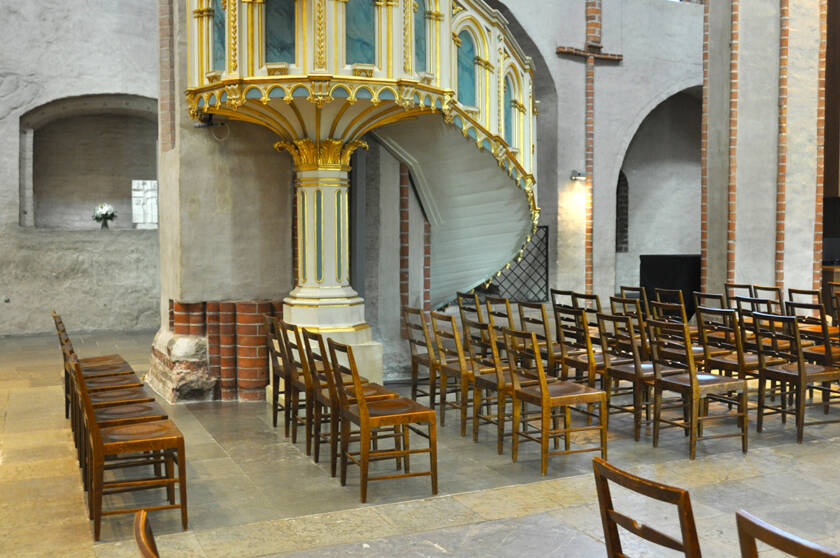
You are now standing beside the pulpit, on the side of the central nave.
On 18 June 1300, the second day of the Cathedral’s consecration celebrations was held. On that day, Saint Henry was established as one of the Cathedral’s patron saints. At the same time, his relics were brought into the church. During the Middle Ages, the reliquary containing Henry’s relics was kept roughly at this location. According to Catholic belief, the holiness of a saint remains in their relics even after death. Thus, Henry’s relics were regarded as Saint Henry himself.
At that time, ordinary parishioners did not have access to this part of the Cathedral. Prayers to saints were to be offered at the altars dedicated to them. However, on feast days, the reliquary kept here was carried in procession around the church, allowing parishioners to touch it. With the Reformation in the 16th century, under the leadership of King Gustav Vasa of Sweden, all valuables were confiscated from churches. The silver reliquary of Saint Henry disappeared—most likely ending up in the Swedish royal treasury.
Already in the early Christian Church, the idea had developed that saints acted as intermediaries between ordinary people and God. This is not unique to Christianity; similar beliefs about supernatural figures can be found in other religions as well. Saints who had died as martyrs were considered especially powerful in this role. Through their strong and perfect faith, they were seen as having attained a partly divine status between God and humankind. According to the legend, Bishop Henry died a martyr’s death.
According to this belief in saints, relics were regarded as embodying the saint itself. For that reason, they were preserved in churches and held in great esteem. They were treated with reverence, but also in practical ways: different churches exchanged relics with one another. It is therefore assumed that only part of Henry’s bones was kept here.
The bones of Saint Henry were placed in a reliquary and kept in this area, in the front part of the Cathedral. In the 16th century, during the Reformation, all the church’s material treasures came under the ownership of King Gustav Vasa of Sweden. Even before that, Danish raiders had plundered Turku, and some valuables had already been taken to Denmark.
Although the reliquary itself disappeared in the 16th century, the bones remained in the Cathedral for some time. It has been suggested that they were eventually stolen in the 18th century during the period of Russian occupation known as the Great Wrath, and may have ended up at the bottom of the Gulf of Finland after a Russian ship carrying them was wrecked. As late as 1720, a detailed inventory was made of what were believed to be Henry’s relics in the Cathedral. This inventory was compiled before they were intended to be transferred to Saint Petersburg for the Tsar’s collections of antiquities. It remains unclear how far this plan progressed. According to tradition, the ship carrying the relics sank on its journey from Turku to Saint Petersburg.
Thanks to the grand translation celebration held in 1300, 18 June became established in the calendar as a special feast day of Saint Henry, known as “Summer Henry.” “Winter Henry” is observed on 19 January, which is also the name day of Heikki and Henrik in the Finnish calendar. The date was previously 20 January, said to be the day of Bishop Henry’s death, but it was later changed because that date coincided with other saints’ feast days. Saint Henry thus had two feast days each year. Major feast days attracted visitors from afar, and markets often developed alongside them. The Summer Henry market typically took place around mid-June.
Station 5: The skull of Bishop Henry?
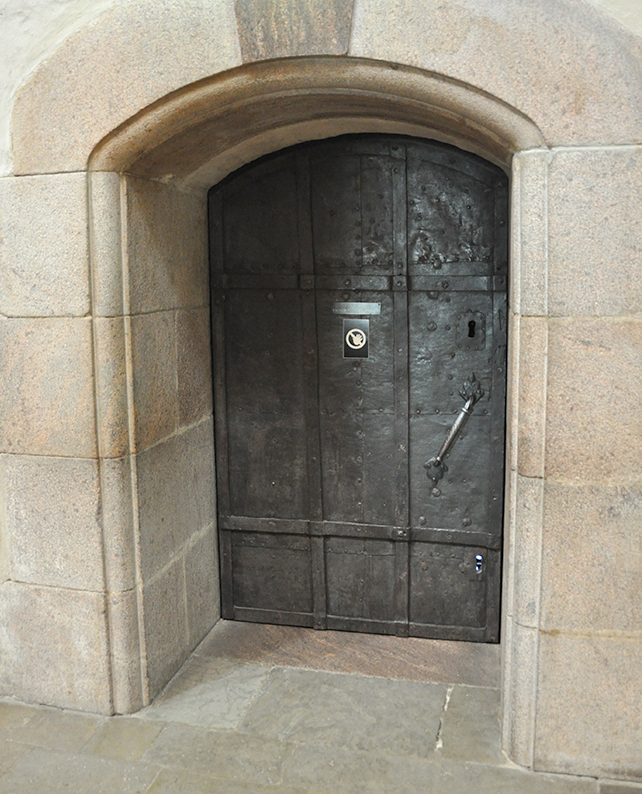
Stop here at the door of the sacristy. It is located to the left of the altar of Saint Henry and Saint Eric. Do not go any further; the sacristy may not be entered without permission. The sacristy is the place where clergy prepare for services.
In 1924, a skull was discovered behind a bricked-up door in the last wall cupboard of the sacristy behind this door. The skull has been examined using modern methods as recently as the 2000s, and it has been determined to have belonged to a person who lived in the mid-12th century. This date fits the legend of Saint Henry. However, we have no proof that Henry was a real historical figure. Could this skull have belonged to the person from whom the legend of Saint Henry originated?
It had long been believed that all of Saint Henry’s bones had disappeared and been stolen during the Great Wrath. In 1720, a detailed inventory was made of what were believed to be Henry’s relics in the Cathedral, because the Russians intended to transfer them to Saint Petersburg for the Tsar’s collections of antiquities. It is not clear how this plan progressed. The ship that was supposed to carry them from Turku to Saint Petersburg is said to have sunk in the Gulf of Finland.
In the 1920s, a major renovation and restoration of Turku Cathedral was carried out. In connection with that work, two upper arm bones were also found in the sacristy cupboard. In addition, the reliquary of Bishop Hemming in the Cathedral was opened, and relic bones were found there as well. Among them was a small piece of bone with a strip of parchment attached, identifying it in Latin as belonging to Saint Henry.
Because the cult of saints involved distributing bones to different churches and chapels in order to bring the saint’s holiness to those places, researchers have been uncertain whether the bones might belong to another saint. The division of relics was more common in the Middle Ages than preserving entire bodies. For this reason, the Cathedral has also contained remains of other saints. All the discovered bones have been studied. In the 1920s, it was suggested that the skull had belonged to a man of about 50 years of age, a cultivated individual who had eaten soft food, and whose skull shape was thought not to represent a typical Finnish type. More recent studies have confirmed that the skull dates to the 1150s. All of this fits Bishop Henry—or at least his story. However, modern researchers do not unanimously support this interpretation, and advanced scientific methods are not expected to provide a definitive answer.
The cupboard door was bricked up in the early 19th century; before that, it had already been nailed shut. At the time it was sealed, it was probably not known that relics had been hidden behind it. When the door was originally nailed shut, was it a deliberate attempt to hide the saint’s bones? The skull is still preserved in Turku Cathedral today, although no longer in the sacristy. The small bone fragment bearing the parchment identifying it as a relic of Saint Henry has been deposited in Saint Henry’s Cathedral in Helsinki.
Station 6: Fresco of Saint Henry baptizing Finns at the Kupittaa spring
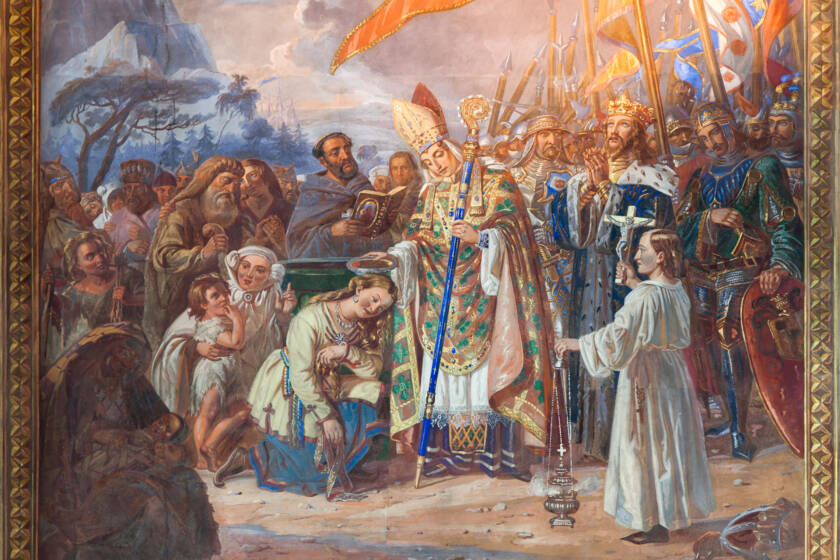
When you stand at the very front of the Cathedral in the chancel, you are in the Chapel of All Saints. On your right, high up, in the fresco farthest from the altar, Bishop Henry is depicted baptizing Finns at the Kupittaa spring. This is the only visual representation of Bishop Henry in this Cathedral. Images and sculptures of Saint Henry can also be found in other medieval churches in Finland, as well as in Sweden and even Italy.
In the image, Bishop Henry is baptizing Finns at the Kupittaa spring. The fresco represents artist Robert Ekman’s interpretation of the First Crusade to Finland. In the 1850s, when it was painted, it was still believed that the crusade had taken place as described in the Legend of Saint Henry. Behind Bishop Henry stands King Eric, and to the left, in front of a tree, is Lalli with an axe on his shoulder. The fresco already reflects the spirit of 19th-century national romanticism, with the woman kneeling before the bishop dressed in traditional costume.
In reality, such a scene never took place. Turku did not yet exist in the 1150s, when Erik and Henry are thought to have arrived in Finland. According to current knowledge, Turku developed between approximately 1280 and 1300 on “this side of the river.” This Cathedral was built just beside what was then the town center. (The Turku expression “this side of the river” is understood from the perspective of the Cathedral: it lies on this side of the river, while places such as the present Market Square are on the other side.)
Ekman painted these frescoes in the mid-19th century. The Great Fire of Turku in 1827 destroyed the entire interior of the church, and the frescoes were painted afterwards. A fresco is a painting made directly onto a wet wall surface so that the paint binds to the wall as it dries. Fresco painting is a technique thousands of years old, but the frescoes in the Cathedral are the first frescoes in Finland.
Author and sources:
Written by Pääsky Vyyryläinen, a student of religious studies and theology at the University of Helsinki. The text was produced during a work placement period at Turku Cathedral. Pääsky writes: “I am fascinated by religious studies and church history because I find it intriguing to explore and reflect on how much religions and our beliefs have influenced—and continue to influence—us and the course of our history.”
Ahlamo, Eeva-Kaisa (2020). Video: Turun tuomiokirkko: Piispa Henrik.
Haavio, Martti (1967). Suomalainen mytologia. WSOY: Helsinki.
Haavio, Martti (1948). Piispa Henrik ja Lalli. Werner Söderström Ltd Printing House: Porvoo.
Heikkilä, Tuomas (2006). Pyhän Henrikin legenda. Kirjapaino Karisto Printing Ltd: Hämeenlinna.
Rinne, Juhani (1932). Pyhä Henrik, piispa ja marttyyri. Otava: Helsinki.