
Cathedral prayer path
Prayer beads, developed by Martin Lönnebo, a bishop of the Church of Sweden, are also used by many Finnish Christians. On this path, you can pray inspired by them in different parts of the Cathedral. According to the story behind the prayer beads, Bishop Martin Lönnebo was sailing in the Mediterranean when a storm struck. While waiting for the storm to pass on an island, Lönnebo began to design a “spiritual lifeline” that would help people find suitable words for prayer. The result was a widely popular and versatile string of beads. In Finland, ready-made prayer bead strings are sold by Sacrum. There are also many devotional books related to Lönnebo’s prayer beads, and many people make their own.
With this prayer path, you can pause in different chapels and details of the Cathedral, reflecting on history, humanity, God, and life. If you wish, you can use the Cathedral’s virtual tour while following the prayer path.
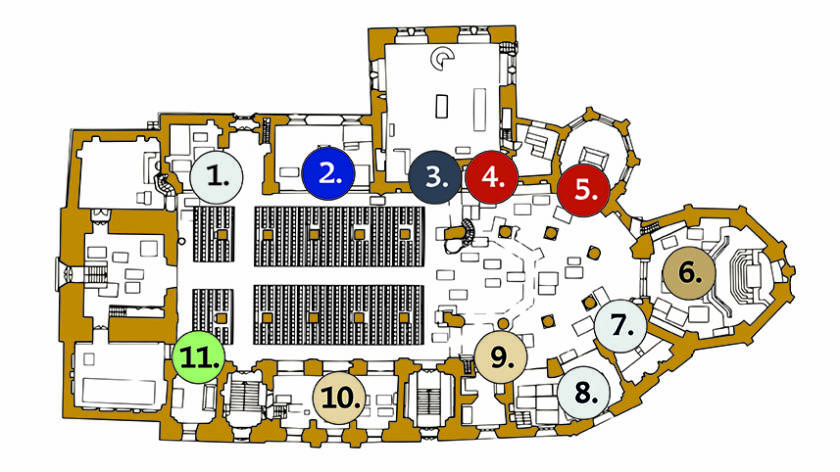
1. St. John Chapel / Kijk Chapel
John replied, “I am the voice of one calling in the wilderness: Make straight the way for the Lord!” John 1:23
“Through baptism we too were joined / to the journey of the people of the Lord,
to show mercy to one another / and to bring peace to conflicts.” Hymn 442:2
In baptism, as a sign of the cross, you inscribed your word in me: You are mine; I will never abandon you. (The Baptism bead)
The chapel, built in the 1440s, was dedicated to two Johns: John the Baptist, a cousin of Jesus, and John the Evangelist. Baptisms have been conducted in the chapel since its earliest days. The limestone baptismal font located at the back of the church originally stood in the chapel on a special limestone slab. The placement of the font at the back of the church symbolizes baptism as the gateway to the congregation.
2. Tavast Chapel / Corpus Christi Chapel
“My God, I trust in you; let me not be put to shame, nor let my enemies triumph over me.” Psalm 25:2
“O Lord, come and bless / these shores of our dear homeland,
Grant us lasting gentle peace / and keep away the horrors of war,” Hymn 577:5
Lord, you know what I need. Help me not to be consumed by worry. (The bead of holy simplicity)
This chapel was founded in 1421 by the Catholic bishop Magnus II Tavast. Its altar once featured a sculpture of the body of Jesus in the lap of his mother Mary, as well as a “Christ in the tomb” sculpture. These valuable objects are now housed in the Turku Cathedral Museum. The chapel later became a burial chapel, where many war heroes have been laid to rest. One of them is Evert Horn, who died at the age of 30 in the Battle of Pskov in 1615. He was a close friend of King Gustav II Adolf, and the king deeply mourned his friend. At this chapel, one can reflect on the suffering endured by all those affected by war.
3. Altar of St Henry and St Eric
“In this kingdom the weak are strong, the sick heal the healthy, the receiver helps the giver.” Hymn 428:5
“My grace is sufficient for you, for my power is made perfect in weakness.” 2 Corinthians 12:9
My God, where are you? Into your hands I commit my spirit. (The Night bead)
The Cathedral is dedicated to Saint Henry, who, according to legend, brought Christianity to Finland around the year 1155. According to the legend, he died for his faith. The history of the church includes periods in which the strong have ruled over the weak, and the actions of the church have also caused suffering. At the same time, even today many people suffer because of their faith. Jesus knows what pain and suffering are, as well as favor and power. He stands beside the weak, the sick, and the dying.
4. Gezelius Chapel / St George Chapel
“Speak, Lord, for your servant is listening.” 1 Samuel 3:10
“One thing I ask, O Savior, one thing I ask today:
Show me the path for just this day, the step I am given today.” Hymn 525:3
Feed me with love, O God. (The first bead of love)
In a small recess lies the final resting place of three important bishops. The shrine contains relics of Blessed Bishop Hemming, and two notable bishops bearing the name Gezelius rest beneath the floor in front of the chapel. The role of a bishop has always carried great responsibility. Yet within the congregation, each of us has our own calling in the work of love. Each one is important.
5. Kankainen chapel
Hannah became pregnant and in due time gave birth to a son. She named him Samuel, saying, “I asked the Lord for him.” (1 Samuel 1:20)
When children hurry off to school, lead them, Jesus, and stay very near the weary mothers. Make homes happy. (Hymn 524:3)
As you love, let me love. (The second bead of love)
In the center of the chapel, in a sarcophagus, rests Karin Månsdotter, whose journey to becoming Queen of Sweden and a beloved figure in Finnish history is complex. Karin became the mother of the king’s child at the age of 15 in 1566. At that time, she was officially still a lady-in-waiting at the court of King Erik XIV of Sweden. Soon they married, and Karin was Queen of Sweden for three months. Amid the intrigues of court politics, she and her husband were imprisoned, separated from their children, and she was widowed at a young age. In the end, however, she was able to live peacefully with one of her children at Liuksiala Manor, where she managed the estate for 35 years and was respected by the local farmers. Karin’s story offers strength to all who face injustice in matters of parenthood or who struggle on behalf of their children.
6. Main Choir / All Saints Chapel
“God is present; let us pray to Him, let us worship in holiness.” Hymn 194:1
“God is not far from any one of us: in Him we live and move and have our being.” Acts 17:27–28
You are infinite, you are near, you are light. (The God bead)
The Chapel of All Saints was consecrated in 1485. The main altar of the Cathedral was moved there in 1649. The chancel contains many works by notable artists, depicting key moments in the life of Jesus, the angels of the Book of Revelation, and, from the 19th century, scenes illustrating the arrival of Christianity in Finland. At this altar, people have knelt for communion thousands of times, falling silent before the Lord. Promises have been made to love in good times and in hardship, and godparents have given their blessing on confirmation day. The chancel is no more sacred than any other part of the Cathedral, but near the altar people may be especially moved by its presence.
7. Tott chapel / St Lawrence chapel
“Rejoice in the Lord always. I will say it again: Rejoice!” (Philippians 4:4)
“Sometimes within us a garden of joy begins to grow, everything feels so good that it makes us laugh!” (Hymn 931:1)
You turn my sorrow into joy. (The Resurrection bead)
In the chapel, you can see a large funerary monument depicting Field Marshal Åke Tott and Countess Christina Brahe. In the Middle Ages, marriage and relationships were different from what they are today. However, it may be thought that Åke Tott’s second marriage (his first wife died young) was a source of joy. The grand funerary monument was commissioned by Christina Brahe. In the Cathedral, it is allowed to be joyful and full of laughter.
8. Holy Cross Choir / Mikael Agricola Chapel
“Let the children come to me; do not hinder them, for the kingdom of God belongs to such as these.” Mark 10:14
“Friend of children, look upon me, so small. Wherever I go in the world, you are there to care for me.” From Hymn 492
I am a wonder, a great wonder, and I thank you for that. (The I bead)
The Holy Cross Chapel was formed in the 1470s by removing the wall between the chapels of Saint Bartholomew and Saint Catherine of Alexandria. The space was named the Mikael Agricola Chapel in 2007, in the year commemorating him. The paintings in the chapel are very old: the image of a ship in the corner dates back to the 15th century. The removed wall in the middle of the space gives us an example as well. Today, the chapel is a place for children. Children do not recognize the invisible boundaries created by people. For them, the sacred can be part of play, and all people can come close to one another without prejudice.
9. Tigerstedt-Wallenstjerna Chapel
“Let us go to the dwelling place of the Lord; let us bow down before His throne.” Psalm 132:7
May the road rise to meet you, may the wind always be at your back. May the sun shine warm upon your face, and the rain fall gently upon your fields. Hymn 979
I cannot manage alone; I long for love. Have mercy on me. (The Desert bead)
In the Middle Ages, the chapel was a small vestibule through which people passed on their way to the main chancel. Everyone who intended to go to confession and receive communion passed through here. In the late 17th century, the extension was turned into a burial chapel. At times, the space also serves as a pilgrim chapel. How fitting for a room through which people have journeyed to encounter the sacred since the Middle Ages!
10. Mayor's Choir
“You alone are holy, you alone are Lord, you alone are the Most High, Jesus Christ, with the Holy Spirit, in the glory of God the Father. Amen.” Hymn 126
Take my loneliness; I am yours. (The Silence bead)
God approaches us as Creator, Redeemer, and Sanctifier. (Catechism)
The chapel was built in the early 15th century, and its main theme was the Holy Trinity. Maintained in its time by the city’s mayors and merchants, the chapel served as a meeting place for pilgrims in summer 2021. Work has always been done in this city. Since the Middle Ages, people have traveled far from here and come from afar to trade. Some have too much work, others too little. Some professions are not sufficiently valued. The coronavirus pandemic has been disproportionately difficult for some entrepreneurs. It is easy to focus on our own efforts and feel that others have it easier. On a pilgrimage—and before our Lord—one’s profession or achievements do not matter. Each person is important and beloved to God.
11. Stålhandske Chapel / All Souls Chapel
“Praise Him, sun and moon; praise Him, all you shining stars!” Psalm 148:3
“You, Creator of the heavens, are obeyed by the movement of the stars; the sun, the moon, and all the earth bow before you, O Lord.” (Hymn 597:1)
I praise you together with nature/creation. (The Creation bead)
In the chapel built in the 15th century, a beautiful starry sky shimmers on the ceiling. It was painted by master painter Karl Konst Hellsten in the late 19th century after the Great Fire of Turku. The most devastating fire in Nordic history left almost the entire city in ruins. Adolf Moberg, a student at the Turku Cathedral School, described how the church tower burned like a gigantic torch. The tower collapsed, and the bells melted into lumps of metal in the heat. Yet this sacred building was rebuilt to serve new generations once again. In the Cathedral, the gaze is naturally drawn upward as the light vaults stretch high above. Sunlight enters the Cathedral through different windows. For those who spend time in the church, it is striking how, in spring, the light increases day by day and draws attention to different parts of the Cathedral.
Lönnebo’s prayer beads
The God bead: “You are infinite. You are near. You are light.”
The beads of Silence (oval beads): “Take my loneliness. I am yours.”
The I bead: “I am a wonder, a great wonder, and I thank you for that.”
The Baptism bead: “In baptism, as a sign of the cross, you inscribed your word in me: You are mine. I will never abandon you.”
The Desert bead: “I do wrong and hurt others. I cannot manage alone; I long for love. Have mercy on me.”
The bead of Holy Simplicity: “You know what I need. Help me not to worry.”
The first bead of Love (God’s love): “Feed me with love, O God.”
The second bead of Love (love of neighbor): “As you comfort, let me comfort. As you love, let me love.”
The Creation bead: “You, Lord, created the world, plants, animals, and people. Teach us to value and protect your creation.”
The beads of Mystery: “You see my secrets, God. Make me brave. Comfort me.”
The Night bead: “When the fears of the night come, your angels watch over me in the darkness.”
The Resurrection bead: “You turn my sorrow into joy.”

The Cathedral prayer walk has been planned and implemented by Sinikka Pietilä.