
Saints tour in Turku Cathedral
Who are depicted on the walls and ceilings of the Cathedral? To whom did gunners or washerwomen turn for help? And what happened when Bishop Hemming of Turku was proposed for sainthood?
Background to the cult of saints
From the mid-12th century onward, Finland was integrated into the administration of Sweden in both ecclesiastical and secular matters, and the organization of the Catholic Church became established in the country. One important aspect of medieval life was the cult of saints. Saints were servants of God who, through divine grace, were believed to perform miracles and answer prayers made in their name. Every illness and profession had its own patron saint to turn to in times of need, but also in everyday life.
The Finnish veneration of saints is one indication of how even the remote eastern part of the Swedish realm was already part of a shared European Catholic culture in the Middle Ages. Stories of saints, known as hagiographies, also spread to the Nordic countries, and saints of the Catholic world became familiar and meaningful to people in Finland as well. Hagiographies often exist in multiple versions. The rhythm of the year was defined by the calendar of saints, which forms the basis of today’s name day calendar.
A large number of saints were Christians who died as martyrs, having been killed either in the events described in the Bible or, for example, in the Roman Empire during the 2nd to 4th centuries, when Christianity had not yet been accepted as a religion. In addition, men and women who were believed to have performed miracles both during their lifetime and after their death—meaning that prayers directed to them were answered—were canonized as saints. For people, saints were both a source of comfort and an example of the many different ways in which one could dedicate one’s life to God.
Saints’ altars in Turku Cathedral
At its peak, Turku Cathedral is estimated to have had as many as 42 saints’ altars. These were placed within the church, especially in the front part of the nave and in the side chapels built during the 15th century. A saint’s altar typically contained a relic of the saint—such as a fragment of bone—and often also a wooden statue of the saint. In addition, each altar had its own personnel responsible for the services held there. The Catholic patron saints of the Cathedral were the Virgin Mary, Saint Henry, and Saint Eric.
Set out on the saints tour!
The map below marks interesting locations related to saints in Turku Cathedral.
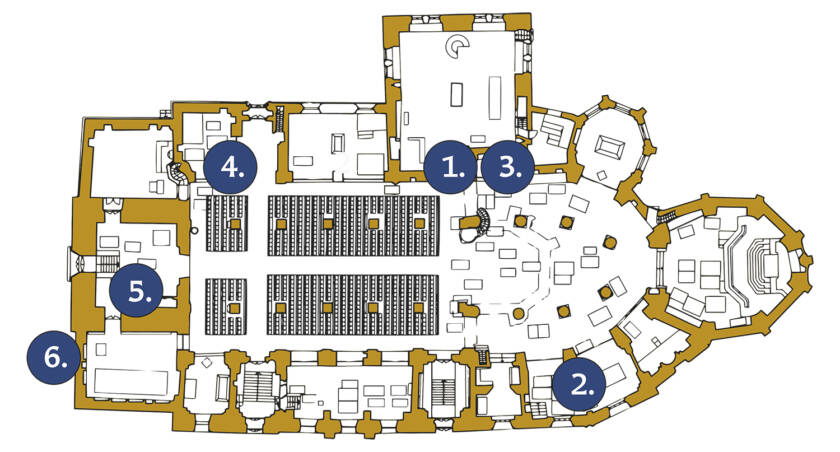
1. Altar of Saint Henry and Saint Eric
At the altar of Saint Henry and Saint Eric, we set sail to the source of the legend of Finland’s origins. Saint Henry is one of the most important saints of the Cathedral: he is one of its patron saints and also the only saint who is believed to have worked in Finland.
Henry, a bishop of Uppsala of English origin, sailed to Finland together with King Eric of Sweden in the mid-12th century. Stories about this First Crusade were spread through the Legend of Saint Henry, which was compiled in the late 13th century. In the legend, the First Crusade takes on a rather warlike tone:
But since the Finnish people, then blind and cruel pagans, often caused great harm to the inhabitants of Sweden, the holy King Erik took with him the blessed Henry from the church of Uppsala, gathered an army, and set out on a campaign against the enemies of Christ’s name and of his own people. When he had forcibly brought them to Christianity and under his own rule, baptized a great number of them, and established churches in those regions, he returned to Sweden as a glorious victor.
Bishop Henry met his end in the year 1156, when a peasant named Lalli, in a fit of anger, killed the bishop on the ice of Lake Köyliö. According to the Legend of Saint Henry, the reason was that Henry had reproached him for committing a murder. According to verses later recorded in the Ballad of Bishop Henry’s Death (17th century), however, Lalli’s wife Kerttu had deceived her husband by claiming that the bishop had failed to pay for the hospitality he had received.
Lalli received his due punishment. He placed the bishop’s mitre on his head and went around the village boasting of his deed. But the mitre would not come off easily—instead, it tore away his hair and scalp.
Henry’s status was sealed through his martyrdom. People began to pray to this miraculous Henry for help. The Legend of Saint Henry tells how the prayers directed to him were fulfilled: diseases were healed and the dead were brought back to life. Through these miracles, Henry demonstrated his holiness.
Henry’s day of death, 20 January, is known in Finland as “Winter Henry,” but because the medieval calendar of saints was crowded on that date, the commemoration was moved one day earlier, to 19 January. On that day, in addition to Henrik, people named Heikki and Henna still celebrate their name day in Finland. “Summer Henry” is celebrated on 18 June, when the bones of Saint Henry were ceremonially brought to Turku Cathedral from Nousiainen in the year 1300.
The other main figure of the First Crusade, King Eric of Sweden, was declared the third patron saint of the Cathedral (after the Virgin Mary and Saint Henry) in the jubilee year 1400.
Our present understanding of the First Crusade differs significantly from what the legend suggests. You can read more about this, for example, in Tuomas Heikkilä’s book The Legend of Saint Henry (SKS, 2005).
2. Agricola Chapel or Chapel of the Holy Cross
This Agricola Chapel was previously known as the Chapel of the Holy Cross. It consists of two of the oldest chapels in the Cathedral, which were originally built as separate spaces: the chapels of Saint Catherine of Alexandria and Saint Bartholomew. It is also one of the chapels of the Cathedral where medieval wall paintings have been preserved. The paintings date from the late 15th century.
Let us begin from the side of Saint Catherine’s Chapel, that is, the side closer to the main altar. (Stand in the middle of the chapel so that the windows are on your right.) Painted on the ceiling are four female saints, who also had their altars in the chapel: Saint Ursula, Saint Catherine, Saint Barbara, and Saint Anne. With the exception of Saint Anne, these female saints lived in the Roman Empire in the 2nd–3rd centuries, when Christianity was still either forbidden or only partly permitted, and they suffered martyrdom because of their faith.
Saints can often be recognized throughout both the Catholic and Orthodox Christian world by their attributes, that is, their identifying symbols. In particular, for martyrs, the attribute is often the object or instrument by which they were killed. Other symbols associated with saints include the halo, and for martyrs, the palm branch.
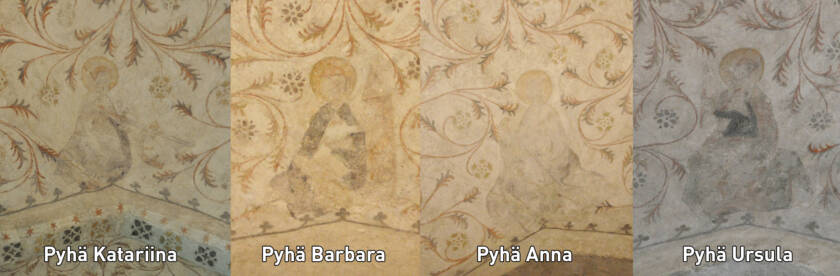
Saint Catherine
According to legend, Catherine of Alexandria was a learned woman who converted to Christianity and refused Emperor Maximian’s order to worship pagan gods. Enraged, the emperor sent dozens of philosophers to oppose Catherine in debate and persuade her to renounce Christianity. The outcome was the opposite: Catherine convinced her opponents to convert to Christianity. The group was put to death as martyrs on a pyre, and Catherine was imprisoned. She was first condemned to be executed on a breaking wheel, but the wheel shattered at her touch. She was then beheaded.
Saint Catherine is the patron saint of all who work with rotating tools, such as millers and spinners. She is also the patron saint of philosophers and female students.
Saint Barbara
A pagan man named Dioscorus had a beautiful daughter, Barbara. Her father locked her in a tower to protect her from the outside world. Even there, Barbara embraced Christianity, and among other things she had a third window added to her tower as a symbol of the Holy Trinity. Her father planned to arrange a marriage for her, but Barbara wished to remain unmarried and therefore prayed to God for help. A lightning strike broke the tower, and the girl managed to escape. Her escape was short-lived, however: Barbara was captured and tortured in an attempt to force her to renounce her faith. She remained steadfast and was sentenced to death. Her own father carried out the execution, but he himself was struck by lightning and turned to ashes after beheading his daughter.
In the Middle Ages, Barbara was invoked for protection against sudden death and against destruction caused by fire and lightning. She is also the patron saint of miners and artillerymen. The story of Rapunzel, locked in a tower, by the Brothers Grimm was also inspired by Saint Barbara. The National Museum in Helsinki displays the Kalanti altarpiece from the early 15th century, which may once have been part of the decoration of Turku Cathedral before it came to Kalanti. This most significant medieval altarpiece in Finland depicts the story of Saint Barbara.
Saint Anne
Anne and her husband Joachim are mentioned in the Apocryphal writings. These are early Jewish or early Christian texts that were not included in the biblical canon. Anne and Joachim were an elderly couple without children, but they prayed diligently to God for a child. One day an angel appeared to Anne and told her that she would bear a child—Mary, the mother of Jesus. Anne is therefore the grandmother of Jesus. Especially in medieval art, the motif known as “Saint Anne with the Virgin and Child” was popular, depicting Saint Anne, the Virgin Mary, and the infant Jesus.
Saint Anne is, among others, the patron saint of homemakers, pregnant women, and those hoping to have children.
Saint Ursula
In one of the many kingdoms of England lived Princess Ursula, a woman who had converted to Christianity. Her father had decided to marry her to a pagan British chieftain, which did not please Ursula. In the Christian ideal of the time, virtues such as virginity and piety were highly valued, and the most devout wished to preserve them. Ursula managed to set conditions for the marriage: she and her companions would undertake a three-year pilgrimage before the wedding, after which she would be ready to marry. Ursula and her companions set out on their journey toward Rome. On their return, however, they encountered a group of Huns in Cologne. The Hun leader attempted to claim Ursula for himself, but when she refused, he killed her with an arrow. The other maidens met a similarly tragic fate.
The cult of Saint Ursula spread widely across Europe. While relics of some saints were rare, relics associated with Ursula were said to number in the hundreds. The maidens accompanying her were recorded as XIMV—perhaps meaning eleven martyr virgins (XI Martyres Virgines), or, as later legend claimed, eleven thousand virgins (XI Mille Virgines). Ursula was invoked for protection against the plague and later became the patron saint of female students.
Saint Andrew, Saint Bartholomew, and Saint Helena
More saints can be found on the walls of Saint Bartholomew’s Chapel. Stand in the middle of the chapel so that the windows are on your left. On the north wall to your right are two male saints.
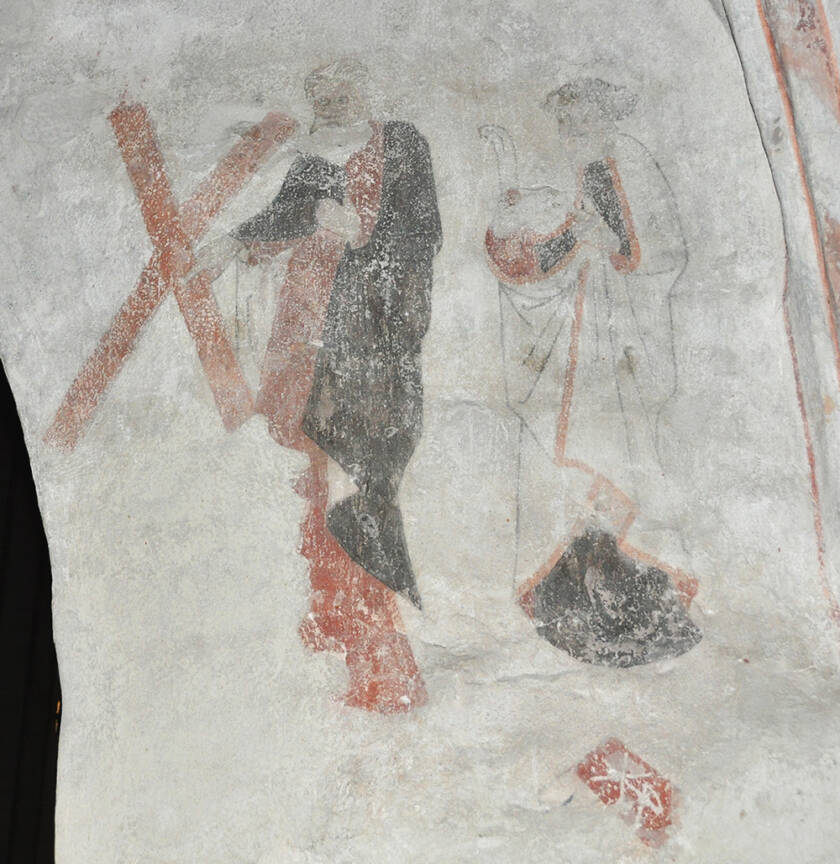
Saint Andrew and Saint Bartholomew were both apostles, that is, disciples of Jesus. After the Ascension of Jesus, the task of the apostles was to spread the Gospel throughout the world. Both men carried out their mission diligently in their respective areas, but they were eventually captured and suffered martyrdom. Andrew was crucified on an X-shaped cross. Saint Andrew is the patron saint of Scotland—this is why the X-shaped cross also appears on the Scottish flag. Bartholomew, known in Finnish as Pärttyli or Perttu, was flayed alive. He is often depicted holding his own skin and a flaying knife.
On the opposite wall is depicted Saint Helena (c. 250–330), the patron saint of archaeologists and divorced people. Helena was the mother of Constantine the Great, the first Christian emperor of the Roman Empire. She made a pilgrimage to the Holy Land, to Palestine and Jerusalem. From her journey, she brought back the cross on which Jesus had been crucified, the so-called True Cross. The feast day of the Inventio Crucis was celebrated on 3 May, and it was also associated with folk beliefs. For example, to ensure good fishing for the year, it was said that fresh fish had to be obtained for fish soup on that day—even from a hole in the ice if necessary.
The Evangelists
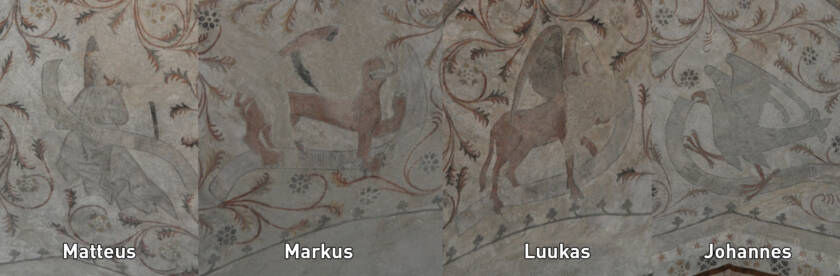
On the western side of the ceiling are the symbolic representations of the writers of the Gospels. In the Book of Revelation, when describing the wonders of heaven, four winged creatures appear beside the heavenly throne. These figures have been assigned to the Gospel writers based on the beginning or character of their Gospels: Matthew is represented by a human, Mark by a lion, Luke by an ox, and John by an eagle. For example, the Gospel of Luke begins with a reference to sacrifice, and the ox was a common sacrificial animal at the time.
One looked like a lion, another like a young ox, the third had a face like a human, and the fourth looked like a flying eagle.
Revelation 4:7
3. The reliquary of Blessed Bishop Hemming
You are now standing in front of a medieval reliquary chest. The chest consists of two parts: inside is the reliquary made in the early 15th century, and it is enclosed within a framework constructed in the early 16th century. The reliquary was traditionally carried in processions during various ceremonies around the altar, and people could touch the chest, thereby coming into contact with the sacred through the relics it contained.
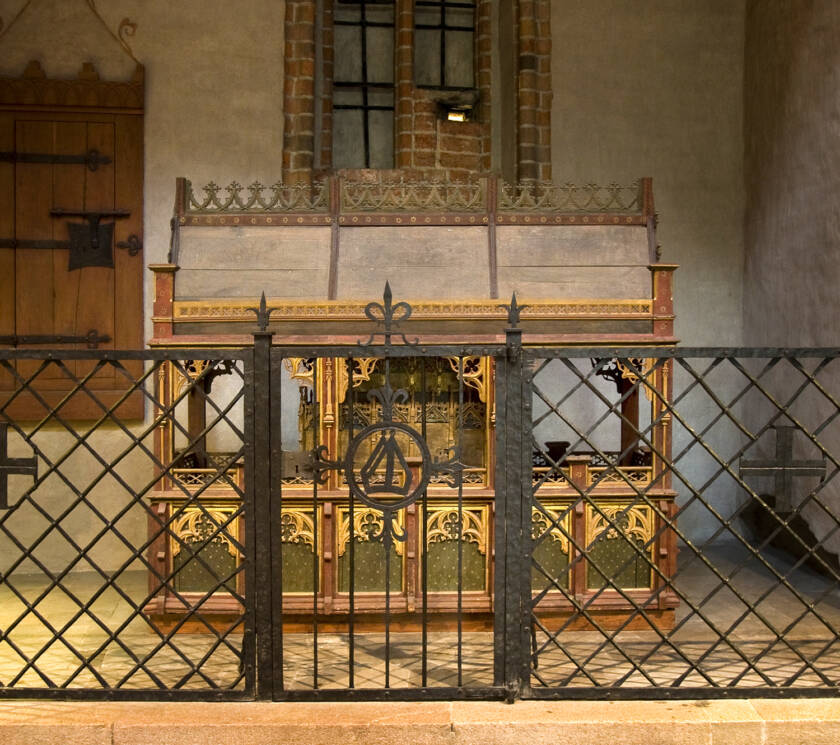
The chest is known as the “reliquary of Blessed Bishop Hemming.” Bishop Hemming served as the bishop of the Diocese of Turku—that is, all of Finland at the time—from 1338 to 1366. During his tenure, he brought the Cathedral to an unprecedented level of prominence and was a close friend of Saint Birgitta, who was later canonized as the patron saint of Sweden and one of Europe’s national saints.
Hemming died while praying, and the memory of the devout bishop remained strong in the Cathedral. Candles were lit daily at his grave until the end of the Middle Ages. People also addressed prayers to Hemming, just as they did to saints. These answered prayers began to be recorded about 50 years after his death, marking the beginning of his canonization process—that is, his path to being declared a saint.
While martyrdom was considered a kind of fast track to sainthood, Hemming had to follow the more traditional process. Once his posthumous miracles had been verified and documented, the evidence was presented to the Pope, who was responsible for canonization. The Pope authorized that Hemming be exhumed and that his remains be placed in a reliquary—there was clearly strong evidence of sanctity in him.
In 1514, a grand celebration was held in the Cathedral in which Hemming was declared “Blessed,” a status that can be seen as a step toward sainthood. He would likely have eventually been canonized, but history intervened. In 1527, the Reformation began in Sweden, and the country’s religion changed from Catholicism to Lutheranism. As a result, the significance of saints diminished, and the reliquary of Blessed Hemming, along with its relics, was stored away in the sacristy for centuries.
4. St. John’s Chapel
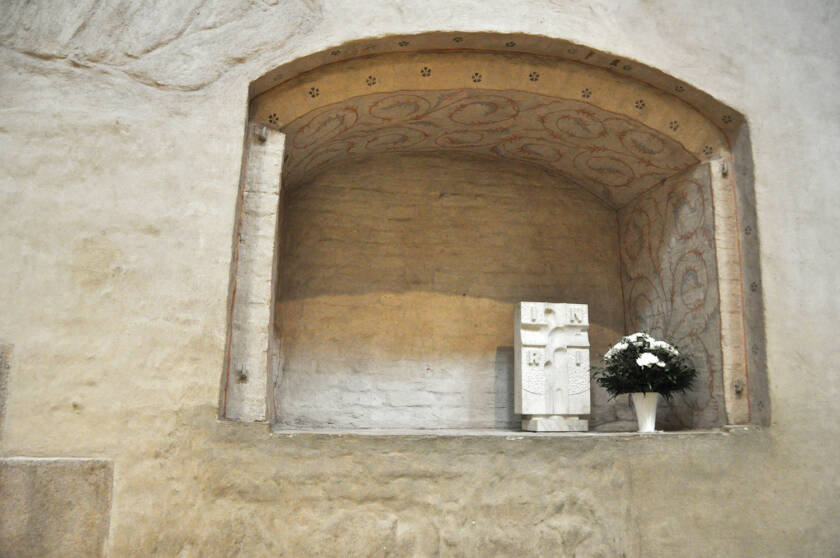
You are now standing in front of the medieval baptismal chapel, St. John’s Chapel. The chapel preserves wall paintings from the 15th century. In particular, the stars and roses on the ceiling symbolize the most important saint of the Catholic Church, the Virgin Mary. To the left of the window, a somewhat worn figure can be seen, interpreted as Saint John the Evangelist, as he is depicted holding a book.
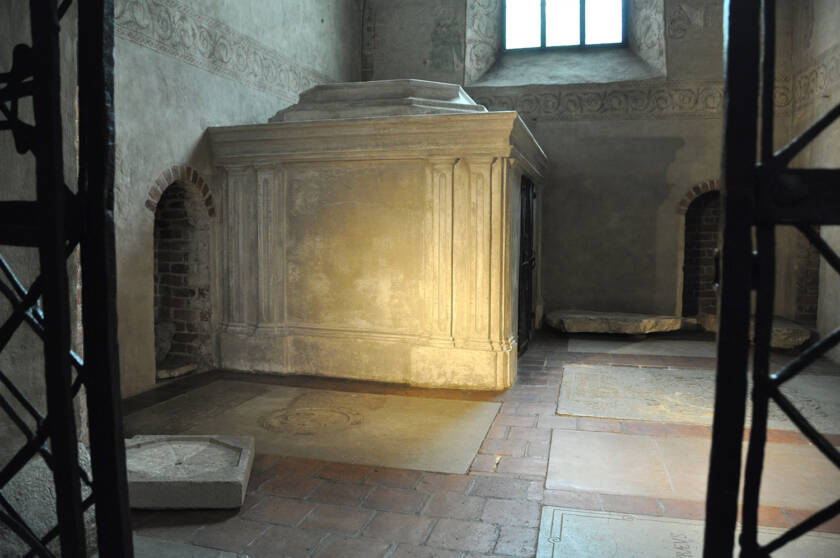
In the niche on the western wall of the chapel, another painting can also be seen. It depicts Saint Veronica and her veil. According to legend, Veronica was a woman suffering from a bleeding disorder who encountered Jesus on the Way of the Cross, as he carried his cross toward Golgotha after being condemned. Jesus healed Veronica of her illness, and in return she wiped his sweat-covered face with her cloth. The image of Jesus’ face was miraculously imprinted on the cloth. Today, this veil is preserved in St. Peter’s Basilica in the Vatican. Veronica is, among others, the patron saint of washerwomen and, naturally, also of photographers.
Veronica is closely associated with the tradition of the Way of the Cross. The commemoration of the Way of the Cross is observed on 5 May. During the Catholic period in Finland, people could make pilgrimages on that day, for example to the Church of the Holy Cross in Hattula, where there was likely a relic believed to be a fragment of the cross on which Jesus was crucified. In these processions, sculptures were carried, and the journey included 14 stations, from Jesus’ condemnation to his burial. Veronica offering her veil is the sixth station of the Way of the Cross.
5. On the saints’ statues in the Museum
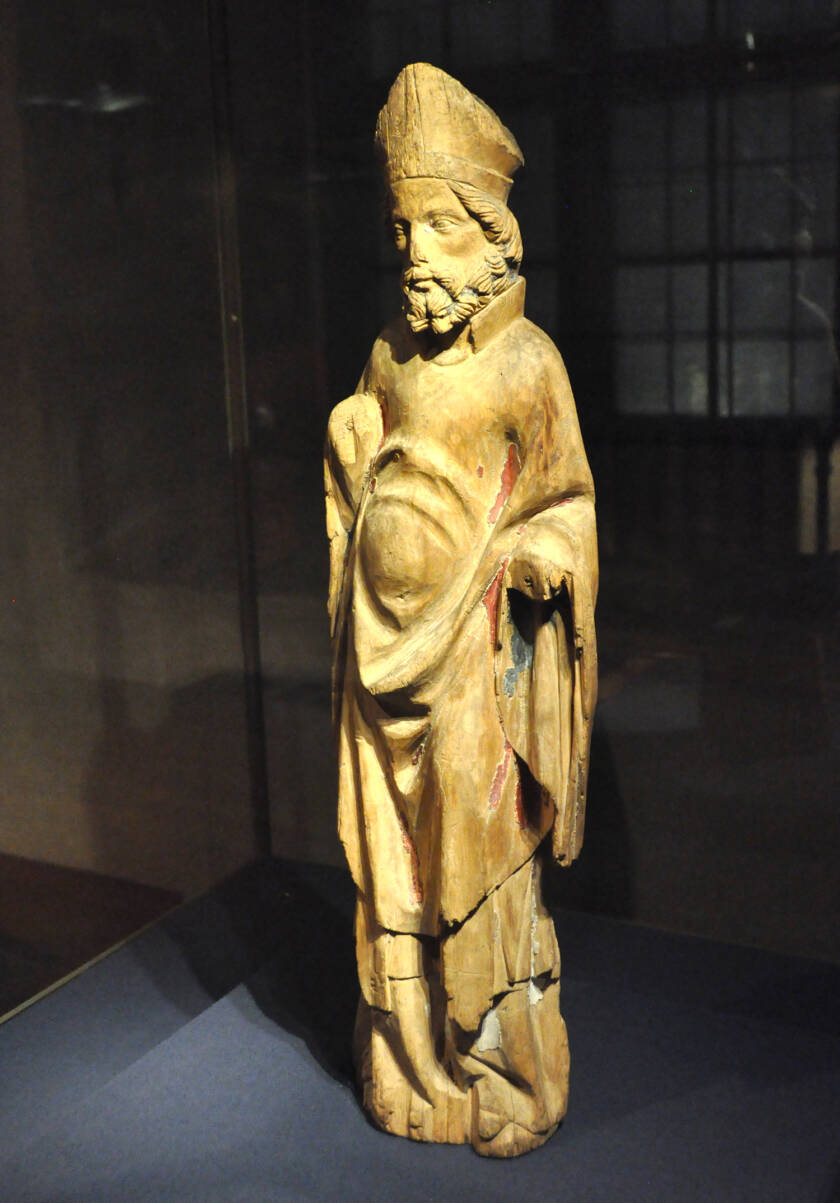
The Turku Cathedral Museum collections contain many old objects from the Cathedral. The museum also houses a few medieval statues of saints, which have miraculously survived in the sacristy storage, even though fires have raged on the church side. These statues were once displayed on the saints’ altars in the Cathedral’s side chapels. They were brightly painted and, with their skillfully carved expressive features, must have evoked awe and reverence among churchgoers during the Catholic golden age. Even today, one can sense the gentle and confident craftsmanship that has preserved the faces of the saints in wood for admiration centuries later.
6. Altar of Saint Christopher
The altar of Saint Christopher is located on the exterior wall of the Cathedral, to the right of the entrance to Domcafé. Christopher, who lived in the Roman Empire in the 2nd–3rd centuries, aimed high: he wanted to serve the greatest king. After even serving the devil, he eventually concluded that the greatest lord of all is Jesus. A hermit advised Christopher that the best way to serve this most powerful lord would be to carry people across a strong current on his shoulders. Christopher was indeed a man of immense strength and great size.
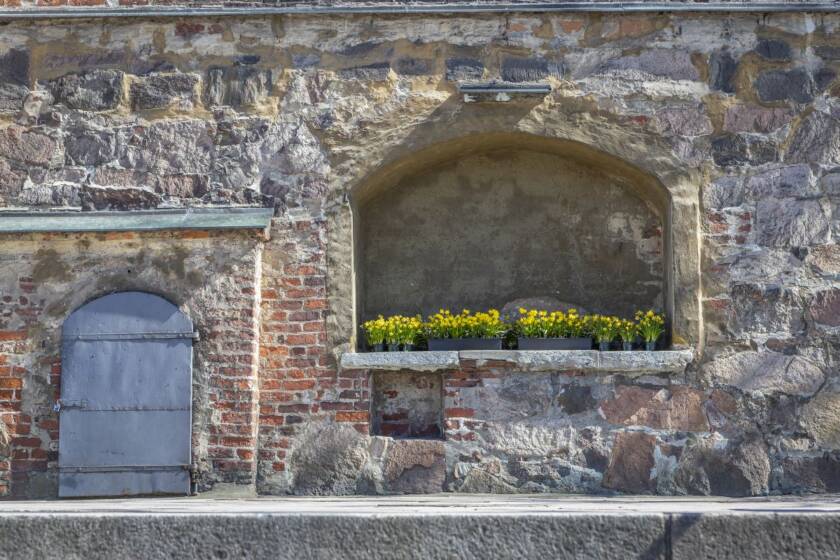
For years, the man carried out this work, growing older and weary. One rainy evening, there was a knock at the door, and the frail old man told the caller to return the next day. But the knocking grew louder, and when he finally opened the door, Christopher saw that the one knocking was a child who demanded to be carried across the river. Christopher believed he could manage such a small burden, so he took his walking staff and the two set out. However, with each step, the weight on Christopher’s shoulders grew heavier. When they reached the far bank, he asked how someone so small could weigh so much. The child replied: “I am Christ, your king, whom you serve in your work. You felt the burden on your shoulders as you carried me, who carries the sins of the world.” Christopher’s walking staff had sprouted leaves, and he left his work to proclaim the faith in Lycia, where he eventually suffered martyrdom.
At the altar of Saint Christopher, the patron saint of travelers, many travelers have stopped over the centuries to pray for protection on their journeys or to give thanks for a safe return. The location of the altar outside the Cathedral was convenient, as even those in a hurry could ask for protection without entering the church itself. Images of Christopher could also be found throughout the city; it was believed that anyone who saw an image of the saint would be spared misfortune that day.
The saints tour was created by Henna Ala-Lehtimäki.