
The History of Katariina Paris
Faith, hope and love since 1309
In the area of the present-day St. Catherine’s Parish in Turku, Christianity has been preached for at least seven centuries. Nummi and Kairinen are among the region’s original villages.
Archaeological material from the old burial ground on Church Hill shows that the influence of Christianity has been felt at this site in one way or another since the 12th century. The area has been inhabited continuously since the Viking Age.
The exact time when the parish of Kaarina or Nummi was founded is not known, but by the early 14th century the church had already been dedicated to St. Catherine of Alexandria.
The earliest preserved written source mentioning the existence of the parish dates from 1309. It is possible that members of the Dominican Order played a role in the early development of the church and the parish, as the Dominicans placed particular emphasis on the life and work of St. Catherine of Alexandria.
St. Catherine’s Church as the Centre of Parish Life from the Middle Ages to the Present
Since the Middle Ages, the centre of the parish’s activities has been a beautiful stone church, whose exact date of origin is difficult to determine. The oldest part of the church is the sacristy, which may have been connected to an earlier wooden church on the site. The nave acquired its present form in the mid-15th century. The vaulting may have been completed during the time of Bishop Maunu Tavast.
The stone church suffered damage from fire at least at the end of the Middle Ages. Traces of this can still be seen, for example, in the sculpture depicting St. Catherine of Alexandria. The church is also associated with another Catholic-era saint, Catherine of Siena. A painting of her was added to the chancel, probably in the 1470s or 1480s. A vicarage has also stood in the immediate vicinity of the church for centuries.
The Ecclesiastical Centre from Nousiainen to Korois Headland
Before the mid-13th century, the ecclesiastical centre of Finland moved from Nousiainen to the Aura River valley. The Bishop of Finland became the Bishop of Turku. It is possible that the parish of Kaarina was established already at this stage.
The region’s first ecclesiastical centre and episcopal seat were located on the Korois headland on the opposite side of the Aura River, only a few hundred metres from St. Catherine’s Church Hill.
The Reformation
In 1517, the German Augustinian monk Martin Luther set in motion a storm that shook the Church. This reform movement, which began in Wittenberg, broke the dominance of the Catholic Church in Northern Europe.
In Finland, the Reformation was implemented relatively moderately. “Excess” property belonging to the Church and its parishes was transferred to the state. This also happened in Kaarina. The Reformation also gave rise to a new kind of parsonage culture in Finland.
The Large Parish of Kaarina
The parish of Kaarina also included islands that were difficult to reach, with long distances to the church. As early as the late 17th century, the inhabitants of Kakskerta and Satava were granted permission to build their own church. However, circumstances changed, and the project could not be carried out for decades. It was not until the late 18th century that the people of Kakskerta and Satava finally obtained their own church and preacher.
Kaarina Parish served as a benefice of the Dean of Turku until the early 19th century. From the perspective of the people of Kaarina, this arrangement was not ideal, as the local community had no influence over the appointment of the vicar. Nevertheless, the system brought many significant and influential churchmen to the parish.
In the early 19th century, the parish became a benefice of the Professor of Theology at the Turku Academy, and it gained independence only after the Great Fire of Turku, when the university moved to Helsinki.
The Church Area in Its Present Form
A new vicarage was completed in 1814. The church was also renovated, and a stone bell tower was built beside it. In this way, the church surroundings of Kaarina acquired the appearance they still retain today.
Burials inside the church were discontinued in Kaarina in 1795. The oldest surviving burial monument is the tomb vault of Bishop Gadolin.
F. G. Hedberg, father of the Evangelical revival movement, serving as vicar of Katariina Parish
During the 19th century, several revival movements emerged in Finland. At first, they were met with resistance from official authorities. The Evangelical movement gained considerable support, especially in Southwest Finland and the Turku region.
Kaarina Parish has had many clergy affiliated with the Evangelical movement. The most notable of these is, of course, the movement’s founder, Fredrik Gabriel Hedberg, who became the parish vicar.
From Kaarina into Katariina
Kaarina Parish grew alongside the city of Turku, and by the early 20th century part of the old rural parish had increasingly taken on the character of a suburban area.
In 1939, the area around St. Catherine’s Church and the Nummi district were formally incorporated into the city of Turku, but this did not bring any changes to the activities or administration of the old parish.
From the late 1970s onwards, the parish population grew rapidly. The development of the Varissuo suburb beyond the older urban area created an entirely new situation.
A major change in the life of the old Kaarina Parish took place at the beginning of 1991, when the parish was divided into two. It had already long operated across the territory of two different municipalities
Varissuo – the parish’s second functional centre
The Varissuo parish centre was consecrated as a church in 1997.
Even today, the past and the present meet in the area of Turku’s St. Catherine’s Parish. This is visible in a very concrete way in the parish’s two church buildings, the old vicarage, and their surroundings.
In terms of style, the parish churches represent completely different periods.
St. Catherine’s Church takes us back to the world of the Middle Ages, while the modern Varissuo Church belongs to an entirely different era.
History of Nummi
The village of Nummi is the oldest settlement on the Aura River
Nummi is the only intact medieval church village in the Turku region. The name indicates that the site is located on a sand ridge formed in a south-north direction during the melting phase of the Ice Age. The area has been continuously inhabited for twelve centuries.
Graves dating from the late Iron Age, the 11th and 12th century, have been examined on the north side of the rectory. The deceased have been buried in a coffin, in the Christian manner, but dressed in their best and equipped with weapons, tools, and food dishes. Archaeological excavations also uncovered remains of a dwelling and metalworking, plough marks from an ancient field older than the graves, and a cremation cemetery. A woman’s grave dating back to the late Viking Age, found in 1950, has been used to reconstruct an ancient costume from Kaarina.
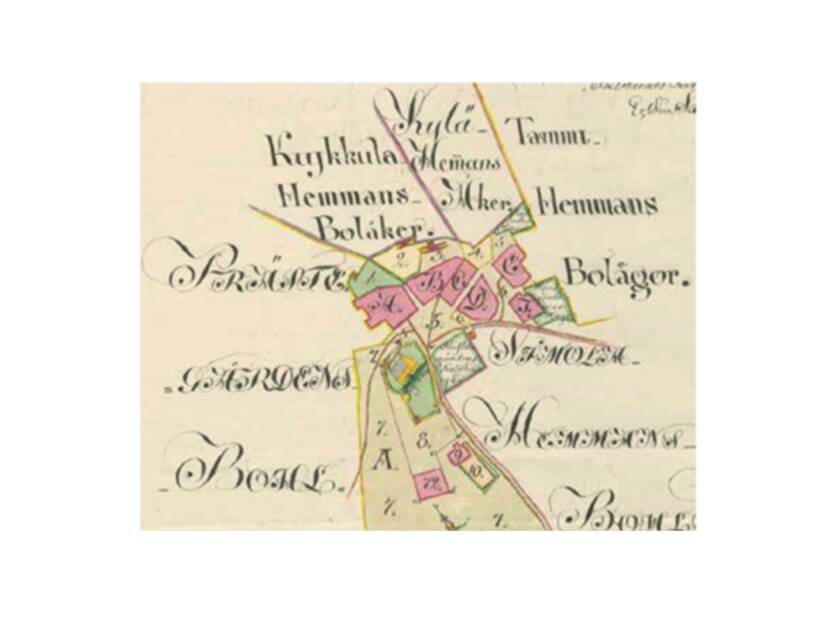
The town
Nummi’s compact group village, which dates back to the Middle Ages, has survived despite going through many changes. Even the great division of Nummi back in 1787 did not break up the village.
The largest fields of the Pappila, Kuikkula and Kylä houses were divided towards the Aura River. The fields of Simola, Veräjänkorva or Korvala and Tammi faced Kuuvuori and Paaskunta.
It was separately decided that the plots and roads of these houses would remain unchanged. The surviving buildings from the old village, Simola, Kylä and Kuikkula, date back to the 18th and 19th centuries.
Simola is now the parish house of Nummi.
The church road (Kirkkotie) is where is used to be. A row of outbuildings remains on the edge of St Catherine’s Church Square. The barns were moved here from their original estate plots during the 19th century. The row of outbuildings is a historical site.
Rectory
Rectory has stood for centuries on the same site, north of the church. The present rectory, which was completed in 1816, was built by professor and vicar Erik Gabriel Melartin. At that time, the St. Catherine’s Church was a salaried facility of the Turku Academy, i.e., the proceeds of the parsonage were used to finance the Academy and the vicars were professors of the Academy.
The parish of Nummi or Kaarina
The village of Nummi was the centre of the parish of Kaarina. The parish house and the first elementary school were located by the cemetery on Kirkkotie. Suburban settlement was concentrated on the common lands of the village of Nummi, on Kuuvuori and further on the farm fields from the mid-19th century until the municipal union in 1939. At that time, part of the municipality of Kaarina was annexed to Turku along the present border.
The medieval Kaarina Church was renamed St. Catherine’s Church when the parish was also divided according to the municipal boundaries in 1991.
School centre
The oldest part of Nummi School was built for the needs of the Nummenmäki suburb in 1930 (architect Aarne Eklund) and further extended in 1937 (Turku City Architect Harald Smedberg). The Aurajoki Community School (architect Pekka Pitkänen, 1963) was built on the site of the Korvala and Tammi houses. The student village has filled the fields along the Aura River since 1967 (architects Jan Söderlund and Erkki Valovirta).
St. Catherine’s Church and its surroundings and the western part of the Student Village are nationally significant, built cultural environments.
St. Catherine’s Church and Cemetery
The church of St. Catherine, which was called the church of Kaarina until 1990, has dominated the landscape of the village of Nummi since the Middle Ages. The church dedicated to Catherine of Alexandria became Lutheran with the Reformation.
The stone church was built in the 1440s and 50s, influenced by Mecklenburg in Germany. The parish was apparently founded as early as the 13th century.
The first written mention of the parish is from 1309. The site was originally a wooden church that had an added stone sacristy. The church, vaulted with three wings, has been well preserved in its medieval appearance.
The Andreas vault refers to the 1400s. The armoury on the south wall dates back to the later Middle Ages. The front hall of the west end was masoned in the 1690s according to the model of the armoury. The medieval windows were re-modelled, and an external door was added to the sacristy in 1903. A single window had already been added to the north wall in the early 19th century.
Lime-painting and medieval sculptures
The emblems of the Evangelists are painted on the choir stalls. Catherine of Siena and the Apostle Peter are painted on the altar wall. The ribs are decorated with vines. The paintings are in the style of the so-called Taivassalo group. The sacristy contains decorations by an earlier group of painters.
A Gothic-inspired wooden sculpture of Catherine of Alexandria has been painted on the altar wall. It dates to the 14th century and is the oldest of the church’s artefacts. The sculpture was blackened by fire during the partial fire that ravaged the stone church. There is a triumphal crucifix on the north wall, a processional crucifix on the altar, a deacon on the west wall of the south aisle and a seated Saint Olaf in the masonry chamber of the armoury. All of these were made domestically around the year 1500.
Structures of a new age
The present pulpit dates from 1654. The wooden sculptures on the pulpit are the work of Matthias Reiman from Turku. The paintings of the evangelists and apostles decorating the front of the organist’s gallery were done by the church painter Jonas Bergman in 1759-60. He also painted the former altarpiece on the north wall of the church hall, depicting the institution of the Eucharist.
The cemetery
Catherine’s cemetery chapel was built in 1929 by architect Ingvald Serenius. It was extended in 1945. The monument of the soldier’s graves (1939-1944) was designed by sculptor Jussi Vikainen.
The neoclassical brick bell tower, which serves as the gateway to the churchyard, was built in 1826. The present Northeast corner gateway dates to 1797.
The churchyard has a brick funeral chapel of the Gadolin family from 1789, an octagonal chapel of the Winter family from 1791 and a tall, Empire-style chapel of the Frenckell family from 1818.
A red-granite monument has been erected on the grave of Mathias Calonius, Professor and Procurator of the Academy of Turku. The sarcophagus is the work of the Swedish architect C. Fr. Drawn by Sundvall and erected in 1822. It is one of the most important funerary monuments in the country.
Around the church you can see the family graves of the Kaarina parish farms. Many of the names of the premises are now part of the city’s public nomenclature. Many historical figures are buried here, from Countesses to the Knights of the Cross of Mannerheim.
The audio guides of St. Catherine’s Church
You can take a guided audio tour of St. Catherine’s Church
QR codes located throughout the church bring its history close to you.
Close your eyes, listen, and you will be transported back in time. There are five guided audio recordings and QR plaques. The recordings are produced by Tuukka Remes of Ääniahjo Oy, in collaboration with staff of St. Catherine’s Parish, its history group, members of the parish council, and experts on the local history.
1. Architecture and art: St Catherine's church through the centuries
Christianity has been preached in the area of the Parish of St. Catherine for at least nine hundred years. The original settlements in the area were in the villages of Nummi and Kairinen. Archaeological findings from the old cemetery on the church hill indicate that the area has been influenced by Christianity in one way or another since the 11th century. Ecclesiastical activities in the area have been documented since the 13th century.
The exact founding date of the Parish of St. Catherine, also known as the Parish of Nummi, is unknown, but it is believed to date back to the 13th century, when other parishes were established in connection with the founding of the episcopal seat. The Dominican Order may have played a significant role in the early stages of the church. The church was dedicated to the martyr St. Catherine of Alexandria presumably at the founding of the parish. The wooden statue of St. Catherine of Alexandria on the altarpiece wall, dating back to the 14th century, is the oldest artifact in the church and has endured much – even surviving a fire in the church, which darkened its surface. Today, the church is also named after Catherine of Siena, who lived in the 14th century and is depicted in a mural north of the choir window.
The first written mention of the parish is from 1309. At that time, a wooden church stood on the site of St. Catherine’s. According to legend, the old church faced destruction in 1396 when German pirates known as the Victual Brothers looted and burned it. However, based on current knowledge, the attack by the Victual Brothers on St. Catherine’s Church is only a legend.
In the mid-15th century, the church was rebuilt in stone. The church was originally planned as a two-aisled design, with only one row of pillars in the center and two windows at the east end. However, the plans changed during construction, and the church was ultimately built with three aisles, following the style of other churches in the diocese. This is indicated, among other things, by the closing of the priest’s door, located on the ”wrong” side of the church, which has been converted into a closet.
The current pulpit dates back to 1654, and its wood carvings are the work of Turku-based Matthias Reiman. The 12-part mural on the organ balcony, depicting evangelists and apostles, is the work of church painter Jonas Bergman from 1759-60. He also painted the former altarpiece on the north wall of the church, depicting the institution of the Lord’s Supper.
In 1804, a bishop’s inspection was held in the Parish of Kaarina, focusing on the condition of the church. According to contemporary accounts, the church was then quite dim, even ”horribly dark.” In 1806-1807, numerous repairs and construction work were carried out in the church, including the addition of a new window in the north wall, allowing light to dispel the darkness. However, by the end of the 19th century, the church was once again in need of restoration, and renovations planned by architect J. Stenbäck were carried out around the turn of the century. The medieval paintings in the choir vault and the east wall, which had been painted over, were revealed and restored, though somewhat heavy-handedly.
In 1990, the Parish of Kaarina was divided into two parishes along the border between
Kaarina and the City of Turku. The part remaining within the territory of the City of Turku was named the Parish of St. Catherine, and its church, the old stone church of Kaarina, became known as St. Catherine’s Church.
2. The Tree of Life
”The tree is one, and all Christians are one”
Looking up at the top of the sacristy vault, one can see a striped diagonal cross formed of red and white bricks. In the center of the cross, there is a white wheel motif, and from its joints, a painted cross, formed by flowering branches, grows. The supporting arches of the vault spread out from the cross like fertile streams, likewise sprouting painted branches.
The sacristy vault is adorned with the symbols of the four evangelists: the lion of Mark, the angel of Matthew, the eagle of John, and the ox of Luke. The chalk paintings on the vault ate back to the late 1400s – half a millennium ago.
The diagonal cross and paintings of the vault symbolize the tree of life, under which the congregation gathers to receive communion. The tree of life is a common theme in
Christianity as well as in many cultures around the world. The tree symbolizes life, the
universe, and the family, providing a shelter where one can peacefully grow.
In the Christian tradition, the tree is present from the very beginning: in the first book of Moses, the tree of life and the tree of knowledge of good and evil grow in the middle of paradise. By eating from the tree of knowledge, humanity loses access to paradise.
The New Testament expands the symbolism of the tree of life in the Bible: the cross of Jesus is the tree of life that brings eternal life. The horizontal and vertical directions of the cross represent the union of heaven and earth.
Today, people in St. Catherine’s Church can gather under the same tree of life as over five hundred years ago. What thoughts, concerns, and hopes did people bring with them at that time? What could we have in common with them?
The theme of the tree of life in St. Catherine’s Church is continued by the baptismal tree designed and implemented by Silja van der Meer, named “Valon pisaroita” (Drops of Light).
The baptismal tree is a tree found in the church space, on which objects are hung for
children baptized during the year. During the year, the tree gradually fills, reminding us of new life and new little members of the congregation.
The baptismal tree is handcrafted and designed specifically for St. Catherine’s Church. The trunk and branches of the tree are knitted from linen yarn, the leaves shaped from crocheted linen. The white doves hanging on the branches are also handmade.
The tree gets its name from the glass beads resembling drops of dew
attached to the delicate green leaves of the tree. As light filters in through
the side windows of the church, the glass beads shimmer like a beautiful and delicate morning dew.
3. Fredrik Gabriel Hedberg
The significance of baptism is emphasized in the Church of St. Catherine. In baptism a
person is called into membership with the congregation and into communion with God, becoming a part of the great tree of life.
Fredrik Gabriel Hedberg, who served as the vicar of Kaarina from 1854 to 1862, highlighted the importance of baptism in his teachings:
”Baptism is not a cheap human act or ordinary, powerless washing with water. It is a divine act and a cleansing rebirth in the Holy Spirit. – – When the holy, triune God commands them baptism of a poor, sinful person in His exalted name, it truly means that God Himself baptizes and adopts them as His child and heir to the kingdom of heaven.”
F.G. Hedberg is particularly known as the founder of the evangelical revival movement. In his youth, he experienced a revival while reading the writings of Martin Luther and became convinced of the perfection of Christ’s atonement and God’s grace.
As the vicar of Kaarina, he initiated a traveling school, improved confirmation school
practices, and organized Bible study sessions on Sunday afternoons. It is said that during these sessions there were as many people present as the church could hold.
Hedberg’s time as the vicar of Kaarina was marked by difficulties and sorrow. In January 1857, the Hedberg family lost their young son Gottfried, and a year later, in March 1858, his wife Maria passed away. Their tombstone still stands to the north of the church. In the spring of 1860, the vicar experienced another bitter loss when his son Gabriel passed away. Despite everything, he trusted in God’s goodness and care.
The Åland war, taking place between 1854-1856, also affected the Kaarina parish
shepherded by Hedberg. During the war, English navy ships arrived in the region’s waters, and Russian and Finnish troops moved through the parish. Troops were even quartered in Kaarina’s vicarage and nearby houses and cottages.
During the war, Hedberg continued his literary work. In 1855, his work ”Baptismens
Wederläggning” was published in Sweden. In his book Hedberg defended and profoundly taught the Lutheran view of baptism. From Kaarina, he also edited an evangelical publication called Christian News (Kristillisiä Sanomia).
In late 1855, English ships left the waters of Turku and Kaarina. During these uncertain
times, the congregation wanted to observe the great celebration of Christendom in
brightness and splendor, and on that Christmas, the church was illuminated by as many as 340 candles and a newly acquired neo-Rococo style chandelier, which still
hangs from the ceiling of St. Catherine’s Church to this day.
Jesus says: ”I am the light of the world. Whoever follows me
will never walk in darkness, but will have the light of life.” John 8:12.”
4. Catherine of Siena – Catherine's Chamber
The image of Saint Catherine of Siena, who lived in the 14th century, was immortalized on the north side of the church’s choir window at the end of the Middle Ages. Catherine is depicted wearing a white dress and a dark cloak, with a crown of thorns on her head. Catherine of Siena was often portrayed with a crown of thorns to symbolize her sacrificial attitude towards life and her dedication to Christ.
The spirituality of the time included mysticism, contemplation, and visions. Early on,
Catherine began to experience visions, often with Christ himself appearing to her and
teaching her. In one vision, Jesus offered Catherine a golden crown, but she chose the
crown of thorns instead.
Catherine’s sacrificial attitude towards life was strongly reflected in her charitable work. She helped the poor and the sick in her hometown. During the dark days of the Black Death, Catherine fearlessly and tirelessly worked to assist those afflicted by the plague and those dying from it.
Catherine prayed, fasted, had visions, and often entered into ecstatic states. Gradually, she started sharing her visions and teachings with the people she encountered. She gathered students and followers around her. The 14th century was a time of great controversies for the Church, and Catherine actively expressed her opinions on current church matters. She addressed not only the Pope and the cardinals but also secular rulers, conveying what God wanted them to do and emphasizing love in decision-making. According to Catherine, the only way to reach God was through love.
Catherine of Siena was considered a saint even during her lifetime, and her status was later officially confirmed. She was canonized in 1461. In 1938, she was named the patron saint of Italy, and in 1999, she was chosen as one of the patron saints of Europe. The dedication of Saint Catherine’s Church to Catherine of Siena indicates the strong influence of the Dominican Order in the region’s history. More recently, the Turku Student Village has been established in the Nummi area, which is quite fitting: both Catherines of the church – Catherine of Siena and Catherine of Alexandria – are patron saints of learned women.
5. Catherine's Chamber
”Create a chamber for yourself in your own mind from which you never need to emerge.” – Catherine of Siena
Catherine’s Chamber is a relaxation exercise that guides the listener into gentle restfulness and meditation, one breath at a time.
Lähteet / källor / sources
F.G .Hedberg: Ainoa autuuden tie. Suom. Lauri koskenniemi (1987)
Hakala, Kari: Pyhän Katariinan kirkon esittely (2010, korjattu 2014)
Heinimäki, Jaakko: Pyhiä naisia ja muita pyhimysesseitä (1995)
Ikonen, Kimmo: Pyhä Katariina – Seurakunnan seitsemän vuosisataa (2011)
Kaarinan seurakunta: Pyhän Katariinan pihoilta – Kaarinan seurakunnan vaiheita (1990)
Katariina Sienalainen: Dialogi Jumalan kaitselmuksesta. Suom. Eva Airava, Kaarina Koho & Tuula Luoma (2011)
Laato, Anni Maria: haastattelu (2023)
Laato, Anni Maria: Kastepuu-artikkeli, Sanansaattaja (2019)
Laato, Anni Maria: Katariina Sienalainen (1374-1380), luento Pyhän Katariinan kirkossa (2023)
Seppälä, Serafim: Elämänpuu. Pyhä risti idän kirkossa (2020)
van der Meer, Silja: ”Valon pisaroita” -tiedote (2019)
Tarkistus ja kommentit: Arkeologi Ilari Aalto, kirkkoherra Leena Kairavuo
Urut, harmoni ja tinapilli: Markku Lautjärvi
Käsikirjoitus, äänitys ja tuotanto: Ääniahjo 0y